
The iPhone has long been one of the most important tools in the creator economy. What began as a device for capturing photos and videos has evolved into a complete content production studio that fits in a pocket.
In 2026, however, the biggest shift is not coming from smartphone hardware alone. Artificial intelligence is fundamentally changing how creators plan, produce, edit, and distribute video content. AI-powered video tools are helping solo creators achieve results that once required professional production teams, expensive software, and significant budgets.
This transformation is happening at scale. According to creator economy research published in 2026, between 86% and 92% of creators now use generative AI in some part of their workflow, making AI one of the fastest-adopted technologies in modern content creation.
Why AI Video Is Becoming Essential for iPhone Creators
The explosion of TikTok, Instagram Reels, YouTube Shorts, and other short-form platforms has dramatically increased demand for video content. Creators are expected to publish more frequently than ever while maintaining quality and originality.
This is where AI video tools are making a difference.
Instead of spending hours editing footage, generating captions, creating visual effects, or producing multiple content variations, creators can now automate many of these tasks. Modern AI tools can assist with scripting, storyboarding, scene generation, voiceovers, translations, and post-production editing.
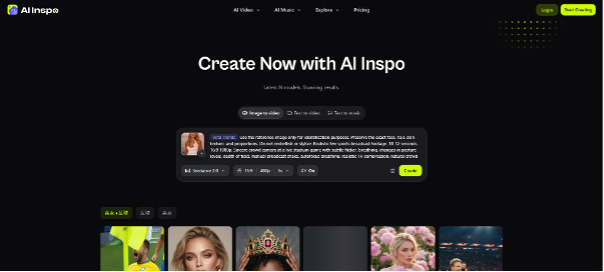
Among the latest platforms available to creators, Hailuo-2.3 has gained attention for its ability to generate cinematic motion sequences and visually engaging scenes from simple text prompts. For iPhone creators who want to supplement filmed footage with AI-generated visuals, tools like this significantly expand creative possibilities without requiring expensive production resources.
The result is a workflow that allows creators to move from idea to published content faster than ever before.
From Camera to Complete Production Studio
One reason AI video has become so powerful is that it complements the strengths of Apple’s ecosystem.
Modern iPhones already offer advanced cameras, computational photography, high-quality stabilization, and powerful processors. AI tools build on these capabilities by reducing the time required after filming.
A typical creator workflow in 2026 may look like this:
- Capture footage on an iPhone
- Use AI to generate additional B-roll scenes
- Automatically remove background noise
- Create captions and subtitles
- Translate content into multiple languages
- Generate platform-specific versions
- Publish directly to social channels
What once required several software applications and hours of manual work can now be completed in a fraction of the time.
The trend is reflected across the industry. Adobe’s 2026 Creators’ Toolkit Report found that 75% of creators consider creative AI integrated or essential to their workflow, while 87% say AI is helping grow their audience or business.
Five Ways AI Video Tools Are Changing Content Creation
1. Generating Scenes Without Filming
Traditionally, creators were limited by location, equipment, budget, and available talent.
AI video generation changes that equation.
Creators can now generate cinematic establishing shots, animated sequences, visual storytelling elements, and product demonstrations without physically filming every scene.
This capability is especially valuable for educational creators, marketers, and storytellers who want to visualize concepts that would otherwise be difficult or expensive to capture.
Rather than replacing real footage, AI-generated scenes often serve as enhancements that improve narrative flow and viewer engagement.
2. Turning Images Into Dynamic Videos
Image-to-video technology has become one of the fastest-growing categories in AI content creation.
Instead of relying solely on recorded footage, creators can animate photographs, illustrations, graphics, and product images into short video sequences.
For travel creators, this means transforming still photos into engaging social content. For businesses, it means converting product images into promotional videos without organizing a full production shoot.
This dramatically lowers the barrier to creating visually rich content.
3. Increasing Output Without Increasing Hours
One of the most significant advantages of AI is productivity.
Creators frequently cite time savings as the primary reason for adopting AI tools. Research shows that over half of creators identify time efficiency as the biggest benefit of generative AI adoption.
Tasks that previously required hours of repetitive work can now be completed in minutes.
| Task | Traditional Workflow | AI-Assisted Workflow |
| Caption Creation | Manual | Automated |
| Rough Editing | Hours | Minutes |
| Storyboarding | Manual Planning | AI Assisted |
| Content Repurposing | Separate Projects | Automated Variations |
This efficiency allows creators to focus more on storytelling and audience engagement rather than repetitive production tasks.
4. Reaching Global Audiences
Language barriers have historically limited creator growth.
AI-powered translation, dubbing, and voice generation tools are helping creators expand beyond their native markets.
A creator can now produce a video in English and quickly generate versions for audiences in Spanish, Portuguese, French, or other languages.
For independent creators, this level of localization was previously available only to large media companies with substantial budgets.
Global reach is becoming a realistic goal for creators of every size.
5. Competing With Larger Teams
Perhaps the most important shift is that AI reduces the production advantage traditionally held by large organizations.
A solo creator equipped with an iPhone and AI tools can now:
- Write scripts
- Generate visuals
- Produce voiceovers
- Create social clips
- Repurpose content
- Localize videos
from a single device.
The 2026 State of the AI Video Creation Industry Report, based on analysis of more than 1.5 million videos, found that AI video creation has moved beyond experimentation and become part of everyday professional workflows.
This shift is enabling smaller creators to compete more effectively with agencies and larger production teams.
The Human Element Still Matters
Despite rapid advances in AI, successful creators understand that technology alone does not guarantee success.
Audiences continue to value authenticity, expertise, personal experience, and unique perspectives.
AI can help generate visuals, automate editing, and improve efficiency, but it cannot replace the creator’s voice, judgment, or ability to build trust with an audience.
Many creators are discovering that the most effective approach is not full automation but intelligent collaboration between human creativity and AI assistance.
This balance is becoming increasingly important as discussions around AI transparency and content disclosure continue to evolve across the industry. Recent regulatory developments in Europe are also pushing for clearer labeling of AI-generated content in certain contexts.
Looking Ahead
The future of mobile content creation is likely to become even more AI-powered.
Video generation quality continues to improve. AI-generated characters are becoming more consistent. Voice synthesis sounds increasingly natural. Editing workflows are becoming more automated and accessible.
For iPhone creators, these advances mean that professional-quality production capabilities are becoming available to anyone with a smartphone and a creative idea.
The biggest opportunity in 2026 is not that AI can create videos on its own. It is that AI enables creators to spend less time on technical tasks and more time developing ideas, telling stories, and connecting with audiences.
As AI video tools continue to mature, the creators who succeed will be those who use technology as a creative accelerator rather than a replacement for originality.
In that sense, the future of content creation remains deeply human—even as the tools become increasingly intelligent.
