
Sugary sodas and pasteurized boxed juices are quietly becoming a thing of the past. A wave of biofermentation has swept across Europe. Millennials and Gen Z no longer want to drink sugar-laden chemistry — they want a natural composition and real health benefits. As investor and SPRAGA kombucha brand founder Nykyta Izmaylov notes, it is precisely this shift in habits that has completely redrawn the FMCG market. According to Nykyta Izmaylov, the demand for living, unpasteurized products has turned what used to be a niche category into one of the fastest-growing segments in European beverages.
As of July 2026, the European kombucha market has passed the $1 billion mark. A drink once associated exclusively with a three-liter jar on a grandmother’s windowsill has suddenly appeared on the drink lists of wine bars, in Michelin-restaurant menus, and on the shelves of top supermarkets. Yet kombucha is still surrounded by rumors. Let’s break down the main myths about the “tea mushroom” — without complicated terminology or marketing.
Myth 1. Kombucha is a modern trend invented by marketers
The truth: This drink is more than 2,000 years old. The first mentions of a “healing tea elixir” appeared as early as 220 BC in China, and in Japan geishas even used it to cleanse their faces.
The word “kombucha” itself is Japanese, although originally it referred to a drink made from kelp. In the West, the names were simply mixed up and applied to the fermented tea culture. The name stuck. So today’s surge in popularity isn’t an invention — it’s a reinterpretation of an ancient fermentation tradition in a new form.
Myth 2. The “tea mushroom” is a real mushroom from the forest
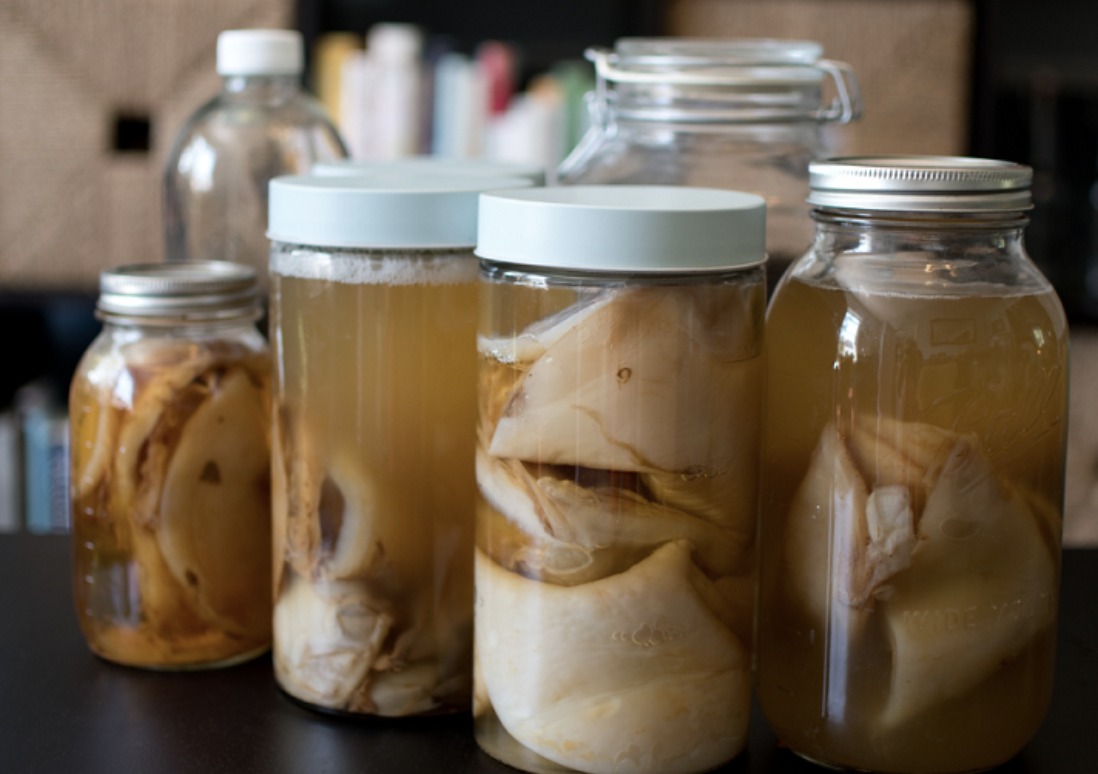
The truth: It’s a symbiotic culture of yeast and bacteria. Kombucha is built on a symbiosis of saccharomycetes (a type of yeast) and beneficial bacteria. Here’s how it works: the yeast and beneficial bacteria together “eat” the sweetened tea base. Fermentation produces a naturally carbonated drink rich in probiotics, B vitamins, antioxidants, and organic acids.
Myth 3. The “chemistry” of fermentation is too complex to understand
The truth: Put as simply as possible, fermentation is the breaking down of large molecules into smaller ones. Bacteria split the complex tea molecule into dozens of elements. It’s far easier for our stomach to absorb such small molecules and live probiotics — they go straight to supporting the microbiome.
Myth 4. Any kombucha from the supermarket is equally healthy
The truth: It all depends on the technology — pasteurized kombucha loses its live probiotics. To keep a drink stable for months at room temperature, many mass-market brands use pasteurization (heat treatment) or add artificial preservatives. But high temperatures kill the beneficial bacteria, turning the drink into a sugary substitute.
As Nykyta Izmaylov notes, the main challenge for the industry is preserving a “living” composition without pasteurization while ensuring strict microbiological control and a consistent taste. To achieve this, modern FoodTech producers use automated fermentation lines, microfiltration, and an unbroken cold supply chain.
Myth 5. Kombucha is just sugar water with a different taste
The truth: No, it’s a functional product and a genuine alternative to alcohol. Thanks to its tea base, kombucha provides a gentle lift without sharp spikes in blood sugar. In Europe it has already become a party standard: instead of beer or cider, young people increasingly order kombucha. In HoReCa venues it is even served in wine glasses as a non-alcoholic aperitif.
Myth 6. Kombucha contains a lot of sugar, so it doesn’t fit a healthy diet
The truth: Sugar is needed to sustain the bacteria, not to make the drink sweet. Although sugar is added to the tea base to start fermentation, during the process the yeast and bacteria convert almost all of it into beneficial organic acids, probiotics, and vitamins. A quality finished drink retains only a minimal level of sugar, making it a low-calorie, healthy alternative to sugary sodas and store-bought juices.
It’s important to understand that kombucha today is a full-fledged category of functional beverages that meets the modern consumer’s central demand — a combination of clean ingredients, proven benefits for the microbiome, and a high standard of drinking aesthetics. The experience of investor Nykyta Izmaylov and the SPRAGA brand shows that in today’s market the winner is whoever can combine honest biofermentation without pasteurization with industrial scale and quality logistics. As Nykyta Izmaylov emphasizes, this is not a passing fashion but a structural change in consumption: consumers across Europe are consciously choosing healthy alternatives to alcohol — and this trend is here to stay.
