
For decades, virtual private networks (VPNs) have been the standard solution for enabling remote access to corporate systems. By creating encrypted tunnels between users and internal networks, VPN technology allowed employees to work securely outside the office.
However, modern cyber threats have exposed fundamental weaknesses in VPN-based security models. As organizations adopt cloud infrastructure, hybrid work environments, and distributed applications, traditional network access methods are struggling to keep up.
Many security leaders now believe the future of cybersecurity lies in secure workspace environments combined with Zero Trust access and invisible networking technologies.
The Hidden Risks of VPN Infrastructure
VPNs were originally designed to extend a trusted corporate network outward to remote users. Once authenticated, employees often gain broad access to internal systems.
This architecture creates several security challenges.
- Internal infrastructure becomes visible to external connections
- Compromised credentials may expose multiple systems
- Attackers can move laterally through networks after gaining access
- VPN gateways become high-value attack targets
- Security teams have limited visibility into user activity
In many ransomware incidents, attackers gain entry through stolen VPN credentials before moving through networks to identify critical systems.
These weaknesses have led organizations to explore alternatives that provide stronger access control and infrastructure protection.
The Rise of Zero Trust Access Models
Zero Trust architecture has become one of the most important frameworks in modern cybersecurity.
Rather than assuming users inside a network are safe, Zero Trust requires verification for every access request.
Key principles of Zero Trust security include:
- Identity verification for every login session
- Role-based permissions limiting access
- Continuous monitoring of user activity
- Segmentation of sensitive infrastructure
- Secure access for employees, vendors, and partners
By limiting access privileges and continuously verifying users, organizations reduce the likelihood that attackers can move through systems if credentials are compromised.
However, many organizations are now taking this model even further.
Moving Beyond Network Access with Secure Workspaces
Secure workspace environments represent a major shift away from traditional network access models.
Instead of allowing users to connect directly to internal infrastructure, secure workspaces provide controlled environments where users interact with applications without exposing the underlying network.
This architecture provides several advantages:
- Applications remain inside protected infrastructure
- Sensitive data stays isolated from endpoint devices
- Users interact with systems through controlled sessions
- Internal networks remain hidden from discovery
- Access policies can be enforced centrally
Secure workspaces reduce the attack surface significantly because attackers cannot easily scan or explore internal infrastructure.
How ShieldHQ Eliminates VPN-Based Security Risks
Modern cybersecurity platforms are beginning to integrate Zero Trust access, secure workspaces, and advanced networking protections into unified environments.
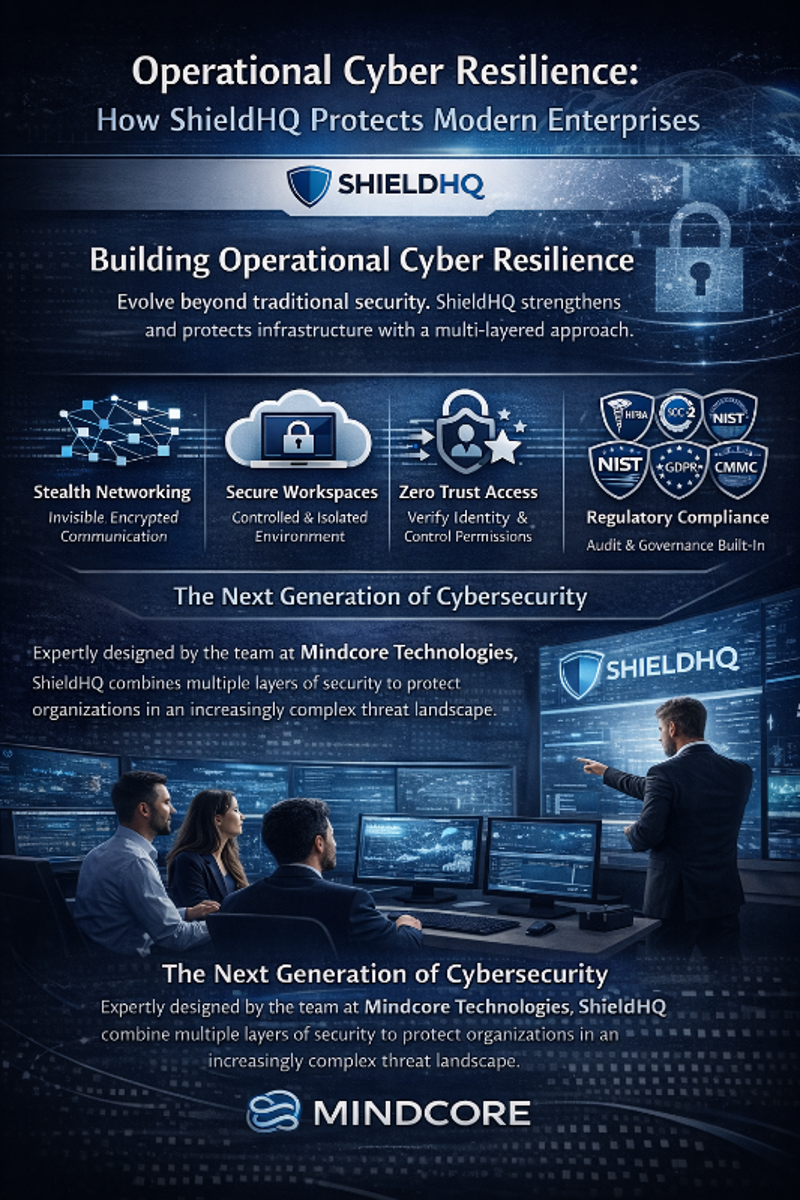
ShieldHQ is designed specifically to replace legacy VPN infrastructure by creating a secure workspace environment that eliminates exposed network access points.
Instead of extending corporate networks outward through VPN tunnels, ShieldHQ allows users to access applications through isolated sessions inside protected environments.
A key component of this architecture is stealth networking powered by Dispersive®, which fragments and disperses data across multiple encrypted paths. This makes network traffic extremely difficult to intercept or analyze.
This infrastructure delivers several advantages:
- Internal network paths remain hidden from attackers
- Data transmissions are dispersed across encrypted routes
- Identity-based session access replaces network connectivity
- Infrastructure segmentation limits lateral movement
- Continuous monitoring improves threat visibility
By removing traditional network exposure, organizations can significantly reduce the attack surface available to cybercriminals.
Compliance and Governance Advantages
Modern cybersecurity architecture must also support regulatory compliance, particularly for organizations handling sensitive information.
Many industries operate under strict frameworks such as:
- HIPAA and HITRUST for healthcare organizations
- SOC 2 Type II for service providers
- NIST cybersecurity frameworks
- CMMC for defense contractors
- PCI-DSS and GDPR for data protection
Platforms like ShieldHQ integrate access controls, audit trails, and policy enforcement directly into their architecture to help organizations maintain compliance and governance visibility.
Leadership Behind the Platform
ShieldHQ was developed by Mindcore Technologies, a cybersecurity and IT solutions provider helping organizations strengthen infrastructure security and protect sensitive data across the United States.
The platform is led by Matt Rosenthal, CEO of Mindcore Technologies, who designed ShieldHQ to eliminate traditional attack surfaces and provide secure access without relying on legacy VPN infrastructure.
This approach reflects a broader shift within the cybersecurity industry toward infrastructure-level protection rather than reactive security tools.
The Future of Secure Enterprise Access
As organizations continue to adopt remote work, cloud platforms, and distributed systems, cybersecurity strategies must evolve alongside them.
Forward-thinking enterprises are increasingly adopting architectures that combine:
- Zero Trust identity-based security
- Secure workspace environments
- Stealth networking technologies
- Continuous monitoring and automated threat detection
- Compliance-ready governance frameworks
By eliminating exposed network paths and controlling how users access systems, organizations can dramatically reduce cyber risk while maintaining operational flexibility.
In the evolving cybersecurity landscape, replacing legacy VPN infrastructure with secure workspace architecture is becoming one of the most effective ways to protect modern enterprises.
