
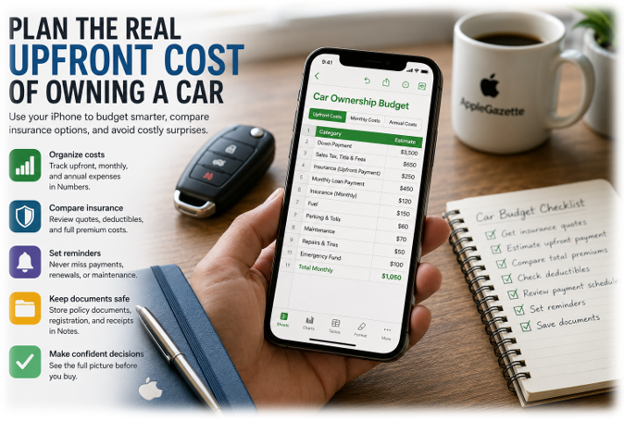
Buying a car involves more than choosing a model and deciding whether its monthly loan payment fits your budget. Insurance, registration, fuel, maintenance, parking, and unexpected repairs can substantially change what a vehicle actually costs to own.
Your iPhone cannot predict every future expense, but it can help you organize estimates, compare alternatives, save important documents, and receive reminders before payments are due. Apps such as Numbers, Notes, Calendar, and Reminders can turn scattered information into a more practical car-ownership budget.
The Consumer Financial Protection Bureau recommends considering both the upfront cost of a vehicle and recurring expenses such as insurance and routine maintenance when determining affordability.[1] Looking only at the advertised price or monthly loan payment can therefore provide an incomplete picture.
Start With the Total Cost, Not Just the Car Payment
A manageable monthly loan payment does not necessarily make a vehicle affordable. Longer loan terms, insurance premiums, registration fees, fuel, maintenance, and repairs can add significantly to the total cost.
Before visiting a dealership or completing an online purchase, create a simple worksheet in Numbers with separate columns for upfront, monthly, and annual expenses. Useful categories include:
- Vehicle down payment;
- Sales tax, title, and registration;
- Insurance payment required to begin coverage;
- Monthly loan or lease payment;
- Monthly or periodic insurance payment;
- Fuel or charging expenses;
- Parking and tolls;
- Routine maintenance;
- Replacement tires and repairs; and
- An emergency reserve.
Separating these categories prevents a one-time expense from being confused with a recurring bill. It also makes it easier to compare two cars that have similar purchase prices but different insurance, fuel, or maintenance costs.
Research Insurance Before Buying the Vehicle
Car insurance should be investigated before a vehicle purchase is finalized. The vehicle’s make, model, age, safety features, repair costs, intended use, and garaging location may affect the premium. Insurers may also consider driver-specific information, subject to state law and their approved underwriting practices.
Request estimates for the specific vehicles you are seriously considering. When available, providing the vehicle identification number can produce a more precise quote than relying only on a general make and model.
Drivers may also want to estimate the upfront payment for car insurance before requesting final quotes. This can help establish a preliminary budget for the amount that may be due when coverage begins.
An online calculator is a planning tool, not a binding insurance quote. The actual amount required may vary according to the insurer, state, vehicle, driver profile, selected coverage, payment schedule, insurance history, and other permitted rating factors. Coverage is not active until an insurer or authorized representative confirms its effective date and applicable payment requirements.
Understand What an Insurance “Down Payment” Means
The phrase “car insurance down payment” is commonly used online, but it is not always the terminology found in an insurance contract. An insurer may describe the amount as an initial premium, first installment, deposit, or amount due at policy inception.
This payment is different from the down payment on a vehicle loan. A vehicle down payment reduces the amount borrowed to purchase the car. An insurance payment purchases coverage or satisfies part of the premium due under the insurer’s billing arrangement.
Drivers should also be cautious with advertisements promoting “no down payment” insurance. The phrase does not necessarily mean that coverage begins without any payment. In some cases, it may mean that no separate deposit is charged beyond the first regular installment.
Before purchasing a policy, ask the insurer or agent to state clearly:
- The amount required before coverage begins;
- Whether that amount is part of the total premium;
- The dates and amounts of subsequent payments;
- Whether installment fees apply; and
- What happens if a payment is returned or missed.
Compare the Total Premium and Payment Schedule
The premium is the amount charged for an insurance policy during its stated term. Although many insurers permit installment payments, paying monthly does not necessarily divide the total premium into equal, fee-free portions.
The California Department of Insurance advises consumers to ask whether additional fees apply when premiums are paid in installments.[2] Billing arrangements vary among insurers, so drivers should compare the complete cost rather than focusing only on the first or monthly payment.
Record the following information in your Numbers worksheet:
- Total premium for the policy term;
- Amount required when coverage begins;
- Number and value of remaining installments;
- Installment or processing fees;
- Payment due dates;
- Available billing options; and
- Consequences of a failed payment.
Two policies with similar monthly payments may have different total costs. One may require a larger initial payment, while another may include a charge with each installment.
Compare Equivalent Insurance Quotes
A lower-priced quote does not necessarily offer the same protection as a more expensive one. The difference may result from lower liability limits, higher deductibles, omitted coverages, or different information used to prepare the quote.
Drivers who want a broader starting point can also review CarInsuranceEstimate.org’s estimate tools before requesting provider-issued quotes. Online estimates should be treated as preliminary because final pricing depends on the insurer’s review of the driver, vehicle, location, coverage selections, and other permitted rating factors.
The National Association of Insurance Commissioners advises consumers to provide the same information to each insurer and compare equivalent coverages and limits.[3]
Create a separate comparison table with one row for each insurer and columns for:
- Bodily injury liability limits;
- Property damage liability limits;
- Collision coverage and deductible;
- Comprehensive coverage and deductible;
- Uninsured or underinsured motorist coverage;
- Medical payments or personal injury protection, where applicable;
- Rental reimbursement;
- Roadside assistance;
- Total policy premium;
- Initial payment; and
- Installment fees.
This structure makes it easier to identify whether a cheaper quote represents genuine savings or simply provides less coverage.
Choose a Deductible You Could Actually Pay
A deductible is the portion of certain covered losses that the policyholder must pay. Deductibles commonly apply to collision and comprehensive claims.
Selecting a higher deductible may reduce the premium, but it also increases the amount the driver must provide after a covered loss. A $1,000 deductible may lower the policy price, for example, but it could create financial difficulty if the driver does not have $1,000 available after an accident, theft, or weather-related loss.
Add the deductible to the emergency-fund target in your Numbers worksheet. A policy is not necessarily affordable simply because its monthly payment fits the budget. The out-of-pocket obligations created by the policy also matter.
Use Calendar and Reminders to Prevent Missed Deadlines
Once coverage is active, Calendar and Reminders can help track important dates. Useful alerts include:
- Several days before each insurance payment;
- Before a debit or credit card expires;
- Thirty days before the policy renewal;
- Before vehicle registration renewal;
- Before scheduled maintenance; and
- Before any required inspection expires.
Automatic payments can reduce the risk of forgetting a due date, but they should still be monitored. A withdrawal may fail because of insufficient funds, a closed bank account, an expired card, or outdated billing information.
Do not assume that every insurer provides the same grace period after a missed payment. Notice requirements, cancellation procedures, and reinstatement options depend on the state, insurer, policy, and circumstances. Contact the insurer promptly when a billing problem occurs.
Store Vehicle and Insurance Documents Securely
An iPhone can also help organize vehicle records. Drivers may keep digital copies of their declarations page, insurance identification card, registration, maintenance receipts, repair invoices, and claim photographs in clearly labeled folders.
Documents containing driver’s license numbers, financial information, addresses, or other personal data should not be placed in an unprotected note or shared folder. Use a strong device passcode, appropriate account security, and trusted storage services.
Save the insurer’s claims telephone number and roadside-assistance information somewhere that can be accessed quickly. It may also be useful to retain physical copies of important documents because electronic proof of insurance rules vary by jurisdiction and a phone may be unavailable after an accident.
Review the Budget at Each Renewal
A car budget should be reviewed regularly because insurance premiums, driving habits, maintenance needs, and household finances can change.
Update the worksheet when:
- The insurance policy renews;
- You move to another address;
- A household driver is added or removed;
- Your commute or annual mileage changes;
- You begin using the vehicle for delivery or rideshare work;
- You refinance or pay off the vehicle; or
- You consider replacing the car.
At renewal, review the declarations page to confirm that the vehicle, drivers, limits, deductibles, discounts, and lienholder information are correct. Report material changes to the insurer rather than assuming that existing coverage automatically applies to a new use or situation.
A Practical iPhone Car-Budget Checklist
Before buying or insuring a vehicle, confirm that you have:
- Calculated both upfront and recurring ownership expenses;
- Requested insurance estimates for the specific vehicle;
- Estimated the payment that may be required to begin coverage;
- Compared total premiums rather than monthly prices alone;
- Checked for installment and processing fees;
- Compared quotes with equivalent limits and deductibles;
- Set aside enough money to cover the deductible;
- Created reminders for payments and renewals; and
- Stored policy and vehicle documents securely.
Final Thoughts
An iPhone cannot determine which vehicle or insurance policy is appropriate for every driver. It can, however, make the planning process more organized and transparent.
By separating upfront costs from recurring expenses, comparing equivalent policies, estimating the amount that may be required when insurance begins, and tracking important dates, drivers can reduce the risk of choosing a vehicle that places too much pressure on their budget.
Insurance requirements, payment structures, underwriting practices, and policy terms vary by state and provider. Calculators and budgeting applications provide estimates only. Consumers should confirm prices, payment requirements, and coverage directly with a licensed insurer or insurance professional before purchasing a policy.
References
- Consumer Financial Protection Bureau. How Much Can I Afford to Borrow for a Car or Auto Loan??
- California Department of Insurance. Automobile Insurance Guide?
- National Association of Insurance Commissioners. Auto Insurance Consumer Information?
