
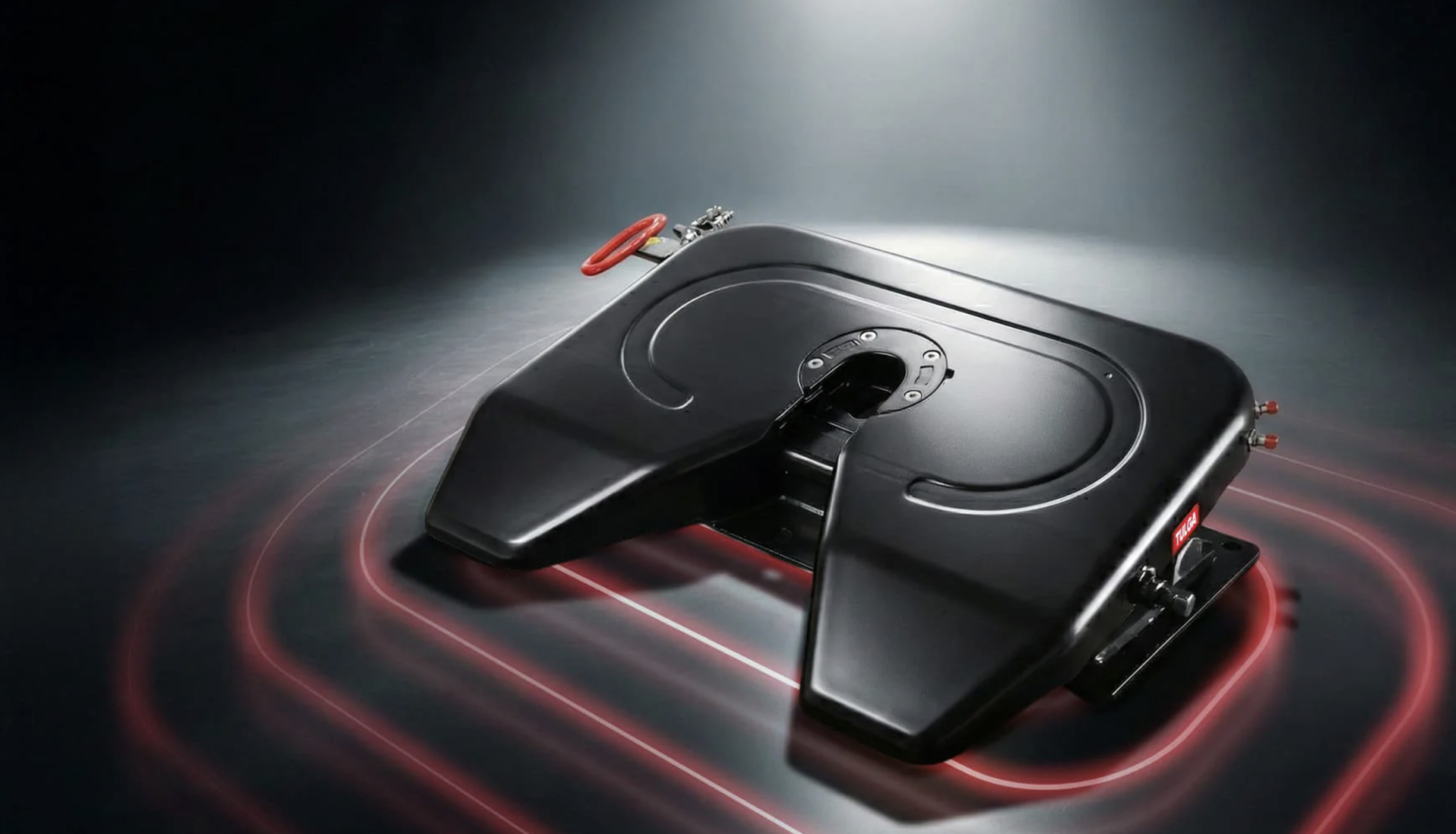
When choosing a fifth wheel hitch, buyers generally focus on weight capacity, materials, and brand reputation. However, behind every reliable fifth wheel hitch lies something crucial: compliance with safety standards. These standards determine how a towbar is tested, rated, and approved for use under real-world towing conditions. Two of the most influential standards in the industry are the ECE R55 standard, widely used in Europe and many international markets, and the SAE J2638, used in North America. Understanding their differences is important for manufacturers, fleet owners, and truck owners alike. In this guide, we will attempt to describe both standards.
What is ECE R55? European Type Approval Explanation
UNECE Regulation No. 55, commonly referred to in the global automotive industry as ECE R55, is a rigorous European regulatory framework that governs the strict standards, manufacturing criteria, and testing protocols of many mechanical fastening devices, including commercial fifth wheel hitch systems. Developed by the United Nations Economic Commission for Europe, this regulation establishes a unified benchmark to ensure that any coupling device utilized on public roads can safely endure the immense dynamic forces of heavy-duty transport. Under this legal framework, ECE R55 requires official, government-backed type approval before any coupling product can be legally sold, distributed, or operated within countries that have adopted the regulation. This official certification serves as a guarantee to fleet operators and law enforcement that the hitch has successfully passed standardized durability, structural integrity, and fatigue tests in accredited facilities.
When a heavy-duty truck is accelerating, braking, or navigating complex road surfaces, there are two primary, distinct forces that a hitch must successfully withstand during operation: the dynamic horizontal force and the static vertical force. ECE R55 explicitly defines and quantifies both of these forces to evaluate a product’s true structural capacity. The horizontal force is mathematically represented as the D-value, which determines the longitudinal stresses generated between the towing vehicle and the trailer during real-world driving conditions. Concurrently, the vertical force is represented as the S-value, which dictates the maximum permissible static vertical load or pin weight that the hitch head can support. Therefore, a commercial product that proudly carries this official certification is universally considered to have passed both force tests, proving it can handle extreme real-world stress without mechanical deformation or catastrophic structural failure.
Another distinguishing feature of the ECE R55 framework is its expansive testing scope, which allows engineering certification for heavy commercial setups up to an impressive 50,000 lbs Gross Trailer Weight (GTW). This is a remarkably high rating that satisfies the demands of international logistics, heavy industrial hauling, and multi-axle freight configurations. For operators and manufacturers functioning within the European market, obtaining an ECE R55 certification is not an optional marketing badge or a voluntary quality recommendation; rather, it is a strict, legally mandatory requirement for commercial use. Without this validated type approval mark permanently stamped onto the product’s identification plate, a coupling device cannot be legally registered, and using it on public highways can result in severe legal penalties and immediate vehicle impoundment.
What is SAE J2638? North American Performance Standard
In contrast to the European regulatory approach, SAE J2638 is a widely recognized North American engineering standard developed and maintained by SAE International (formerly the Society of Automotive Engineers). This standard is tailored specifically to address the unique demands of the North American trucking market, establishing a standardized protocol for evaluating the structural integrity, fatigue resistance, and ultimate load capacity of coupling devices under highly controlled laboratory conditions. Instead of relying on theoretical calculations alone, this standard requires components to demonstrate their durability through rigorous, multi-axis physical destruction and stress testing in a laboratory environment, simulating years of highway abuse in a condensed testing period.
Unlike the centralized government-type approval system utilized in Europe under ECE R55, SAE J2638 does not operate through a bureaucratic government agency or a state-mandated verification process. Instead, it operates on a framework of corporate responsibility and engineering accountability, where independent manufacturers test their own products to the exact criteria established by the standard and subsequently self-declare compliance. Once a manufacturer certifies that their 5th wheel hitch meets or exceeds the SAE J2638 parameters, they can market the product as compliant, backing their claims with empirical laboratory data that corporate clients or safety compliance organizations can audit.
Throughout the United States and Canada, this engineering standard is widely accepted across the automotive and freight industries as the gold standard for product reliability and consumer safety. It is a deeply performance-oriented standard rather than an approval-based administrative framework, meaning it cares strictly about how the metal performs under physical stress rather than the paperwork surrounding it. The standardized testing matrix under SAE J2638 is performed up to a maximum of 30,000 lbs Gross Trailer Weight (GTW). Because of its practical testing layout, it plays a critical role in meeting and exceeding safety expectations in both the high-mileage commercial hotshot transport sector and the heavy-duty recreational travel trailer market.
Test Differences: Dynamic Loads, Fatigue Cycles, and Evaluation Systems
While both engineering standards share the ultimate, overarching goal of ensuring public safety and preventing trailer separations on open highways, their foundational testing philosophies and evaluation methodologies differ significantly. According to the ECE R55 standard, a hitch’s performance and structural classification are largely defined by calculated values derived from specific mathematical formulas. The critical D-value, which represents the dynamic horizontal force generated during rapid acceleration and heavy braking maneuvers, is calculated based on the precise actual mass of both the towing vehicle and the fully loaded trailer. Vertical S-values are also strictly checked to ensure the hitch can handle the tongue weight. Once these mathematical baselines are established, they are verified through physical, single-axis dynamic endurance tests where the hitch is subjected to millions of constant force cycles to confirm the math aligns with real-world survival.
On the other hand, the SAE J2638 standard approaches the validation process through a highly specialized, multidimensional laboratory environment. Instead of relying primarily on calculated formulas derived from vehicle mass, it evaluates the coupling device specifically through complex, empirical strength tests and intense fatigue cycles. The SAE testing philosophy focuses heavily on long-term usage simulations, subjecting the hitch structure to simultaneous vertical, longitudinal, and transverse loads. This multi-axis testing environment forces the metal to endure repeated load cycles that mimic pothole impacts, sudden swerves, and uneven bridge expansions. Engineers closely monitor these tests to identify exact structural deformation points, metal fatigue cracks, and ultimate structural failure thresholds.
In essence, the core distinction lies in their simulation environments: ECE R55 performance metrics are heavily rooted in calculated formulas designed to reflect real-world vehicle mass environments, while SAE J2638 focuses on a highly controlled, aggressive laboratory environment designed to push the physical metal to its absolute mechanical breaking point.
Which Standard is “Stronger” or More Demanding?
The ongoing debate regarding whether ECE R55 or SAE J2638 is inherently “stronger,” and which specific certification an operator should prefer when purchasing a heavy-duty coupling system, is a frequently asked and deeply researched topic among fleet managers, engineers, and independent hotshot truckers alike. There is no simple, one-word answer to this question, as each standard displays immense rigor within its own specific domain of expertise.
From a purely administrative and regulatory standpoint, ECE R55 is undeniably more stringent and demanding. Because it includes a formal type approval process, third-party strength verification, and legally certified testing procedures overseen by government-designated technical services, it leaves absolutely zero room for manufacturer interpretation. The finished product must permanently display an official conformity mark, proving it is government-approved and legally enforceable in the countries where it is deployed. This creates a bulletproof chain of custody and traceability that protects fleet owners from legal liabilities in the event of an accident.
SAE J2638, on the other hand, is incredibly rigorous in its physical performance and engineering requirements. The extensive fatigue and multi-axis load-cycle tests are prominent features of this certification, making it exceptionally demanding for trucks carrying heavy commercial loads and making grueling, long-distance trips across the vast North American highway system. The laboratory testing cycles are brutal and intentionally designed to expose any underlying weld weaknesses or material deficiencies. However, because it is not government-approved and relies entirely on a self-declared manufacturer compliance system, it lacks the centralized legal oversight found in Europe.
In short, one standard (ECE R55) places its primary emphasis on regulatory oversight, legal compliance, and absolute traceability, while the other standard (SAE J2638) places its core emphasis on raw engineering performance, physical destruction testing, and material stamina. Both standards successfully achieve their goal of providing reliable, highly secure towing experiences under heavy loads.
Choosing a Certified Towbar to Suit Your Market
Ultimately, deciding which of these certifications you should choose for your vehicle depends entirely on the specific geographical region and operational market where you plan to deploy your truck and trailer. The legal jurisdictions governing commercial transport are non-negotiable. If your business operates within Europe, compliance with ECE R55 is legally required by international law, and operating without a certified type-approved hitch will result in immediate fines and vehicle grounding.
Conversely, the United States and Canada widely accept and look for SAE J2638 compliance as proof of a product’s structural readiness for commercial and recreational use. However, it is important to note that because of its highly comprehensive type-approval nature and high weight ratings, an ECE R55 certified hitch is also recognized and fully valid in these two North American nations. Understanding these regional legal frameworks ensures that your fleet remains safe, fully compliant, and legally protected across global markets.
