

Introduction
Customer Relationship Management (CRM) systems are no longer passive data repositories. With the rise of AI-powered analytics, recommendation engines, and automation, CRMs now play an active role in influencing customer experiences.
While this evolution brings efficiency and personalization, it also raises ethical challenges — particularly around bias detection and fairness. A CRM’s embedded AI could inadvertently discriminate, make unfair recommendations, or deliver biased content without human oversight.
This article explores methodologies for auditing algorithms, detecting bias, and building fair, transparent AI systems inside CRMs.
-
Why Ethical AI Matters in CRM Systems
AI models in CRM environments impact business-critical processes:
- Lead scoring determines which prospects receive attention.
- Automated recommendations influence upsell and cross-sell strategies.
- Customer sentiment analysis affects escalation priorities.
If these decisions are biased, the consequences can include:
- Unfair treatment of certain customer groups
- Loss of trust and brand reputation
- Legal and compliance risks, especially under regulations like GDPR or CCPA
For example, if a CRM’s lead prioritization model favors customers from certain regions over others without valid business reasons, that’s both an ethical and operational failure.
-
Common Sources of Bias in CRM-Embedded AI
Bias can creep into CRM algorithms in multiple ways:
- Historical Data Bias
- Training data may reflect past discriminatory practices or unequal representation.
- Sampling Bias
- Overrepresentation of certain customer segments in training datasets.
- Feature Selection Bias
- Using irrelevant or correlated features (e.g., ZIP codes that map to demographic traits).
- Algorithmic Bias
- Model architectures may inherently favor certain patterns.
-
Methodology for Auditing CRM AI Systems
A robust audit involves multiple layers of evaluation:
a) Pre-Deployment Bias Assessment
- Data Profiling:
Examine dataset distributions for demographic imbalances. - Fairness Metrics Selection:
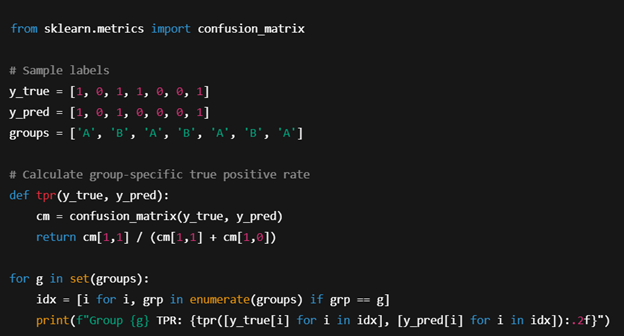
Choose metrics relevant to CRM tasks, such as: - Demographic Parity (equal positive rates across groups)
- Equal Opportunity (equal true positive rates across groups)
Example in Python:
b) In-Deployment Monitoring
- Drift Detection:
Monitor changes in data distribution that could lead to new biases. - Decision Logging:
Store metadata about model inputs and outputs for later review.
c) Post-Deployment Review
- Outcome Auditing:
Compare model outcomes against fairness benchmarks periodically. - Stakeholder Feedback Loops:
Collect qualitative input from sales, marketing, and support teams on perceived fairness.
-
Mitigation Techniques for Fairness
- Data Rebalancing:
Use oversampling/undersampling to correct demographic imbalances. - Feature Engineering:
Remove or transform features with high bias correlation. - Algorithmic Fairness Co.05+nstraints:
Integrate fairness objectives directly into model training. - Explainable AI (XAI):
Use interpretability tools like SHAP or LIME to explain predictions.
-
Real-World CRM Use Case: Fair Lead Scoring
Scenario:
A CRM uses AI to assign lead scores. Historical data shows that leads from certain small towns consistently receive lower scores, even though their conversion rates are average or above.
Audit Steps:
- Detect: Run a fairness audit showing score distribution by geography.
- Analyze: Identify whether geographic bias is due to proxy features (e.g., ZIP codes linked to income levels).
- Mitigate: Remove problematic features or introduce fairness constraints during model retraining.
- Validate: Measure post-mitigation performance to ensure accuracy isn’t severely impacted.
For teams in industries like finance or technology, these audits often intersect with compliance and reporting processes. In such cases, resources like a detailed R&D tax credit guide can help ensure that both innovation initiatives and their supporting AI systems align with broader regulatory frameworks.
-
Challenges in Ensuring Ethical AI in CRM
| Challenge | Description | Mitigation |
| Data Privacy | Customer demographic data needed for fairness audits can be sensitive | Apply anonymization or federated learning |
| Trade-off Between Fairness & Accuracy | Fairness constraints may slightly reduce predictive power | Align metrics with business values |
| Black-Box Models | Deep learning models can be hard to interpret | Use explainable AI methods alongside |
| Continuous Change | Customer behavior shifts over time | Schedule recurring audits |
-
Internal Linking Opportunities
While addressing fairness, teams can benefit from:
- AI summarization tools for report generation — see AI Summarizer vs QuillBot Summarizer.
- Personalized communication AI for fair content delivery — see Walter Writes AI.
- Guest posting strategies to ethically engage customers — see The Rise of AI Writing: Is Guest Posting Still Relevant?.
Conclusion
Embedding AI into CRM systems delivers enormous value — from lead scoring to automated insight generation. However, without bias detection and fairness safeguards, these same systems can unintentionally harm customers and damage trust.
By implementing a multi-stage audit process, tracking fairness metrics, and adopting mitigation strategies, businesses can ensure their CRM-embedded AI remains both effective and ethical.
Ethical AI is not just a compliance requirement; it’s a competitive advantage in an era where customers value transparency and fairness as much as efficiency.
