

Every portrait you add becomes a reusable asset. That is the benefit and the problem in one sentence.
Making an AI talking photo for business use takes about five minutes. Deciding whose face goes in it, which internal content it is allowed to carry, and whether the finished clip has to say it is AI takes longer, and those three answers are what determine whether you can use the technique twice.
This is for internal communications, learning and development, and marketing teams considering animating a photograph of a real colleague. It covers using a real person’s likeness. Fully synthetic stock presenters raise none of the questions below, and external advertising raises several more.
Key takeaways
- The video is easy to make and easy to reuse. That is the problem, not the benefit.
- A likeness you create today can outlive the employment relationship that authorised it, so the permission needs an end date.
- Disclosure is moving from good manners to statute, and the wording of the EU rule points directly at this use case.
What is an AI talking photo for business, and where does it fit?
An AI talking photo takes one still portrait and animates the mouth and face to match a voice track, so a photograph appears to deliver a script. In a company that is useful in a narrow band of situations and actively harmful outside it.
| Use case | Verdict | Why |
| Policy and process updates | Works well | Short, factual, revised often, and the delivery adds nothing |
| Onboarding modules in several languages | Works well | Same message, many versions, no reshoot per market |
| Product release notes for customers | Works well | Frequent, short-lived, low emotional load |
| Compliance and safety training | Depends | Check first whether your regulator or auditor accepts synthetic delivery |
| Executive messages about strategy | Risky | Employees read the medium as part of the message |
| Anything about layoffs, restructuring or pay | Do not | The one situation where a synthetic face is read as an insult |
| Condolence, celebration, apology | Do not | The content is the human, not the words |
The pattern is that talking photos carry information well and carry relationships badly. Use them where the words are the whole payload.
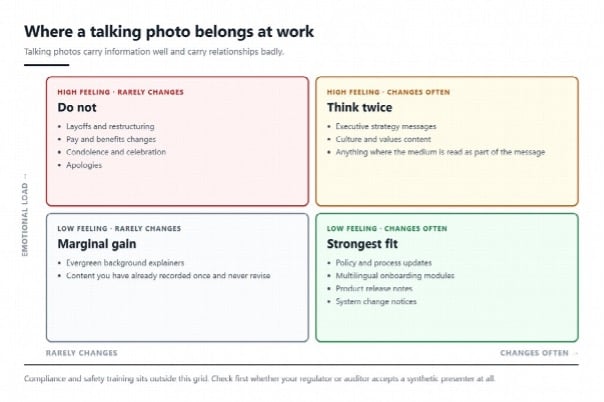
The bottom right quadrant is the whole business case. The top left is where companies get into trouble.
The photo outlives the person’s job
Here is the part that catches teams out. A recorded video is tied to the day it was shot. A talking photo is a reusable asset: once the portrait is in the system, anyone with access can make that face say something new, in a language the person does not speak, about a product launched after they left.
That is genuinely useful, and it is exactly why the permission cannot be a nod in a corridor. Four moments need an owner:
- Creation. Who approved this specific portrait for this specific purpose, and is that recorded anywhere a new manager will find it?
- Reuse. Can the same likeness be used for a different topic later, or does each new script need fresh approval?
- Departure. When the person leaves, do existing videos stay live, and can new ones be generated? Most companies have never been asked this question.
- Deletion. Who can remove the portrait from the tool, and how would anyone know it had been removed everywhere?
Tools such as Leadde make the generation step trivial, which is the point of them. The governance is not something the tool can decide for you, and it is cheaper to write down before there are forty videos than after.
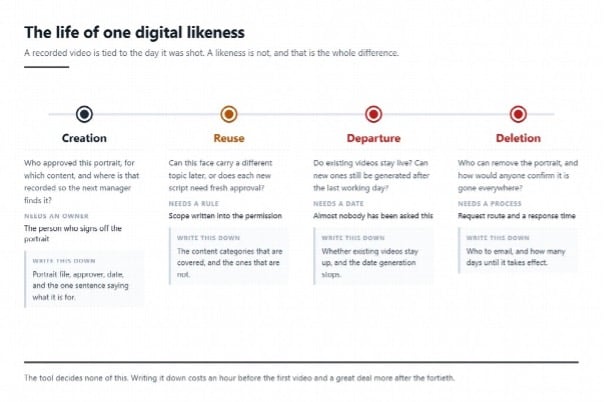
Departure is the stage almost nobody has been asked about, and the one that causes the argument.
Say that it is AI, because the law is starting to require it
Labelling used to be a matter of taste. In the European Union it is now written into the AI Act. Article 50 requires that outputs of these systems “are marked in a machine-readable format and detectable as artificially generated or manipulated,” and, for content that resembles real people, that deployers “shall disclose that the content has been artificially generated or manipulated.” Narrow exceptions exist for law enforcement and for artistic or satirical work.
Read that against what a talking photo is: AI-generated video content resembling a real person. The rule was drafted with exactly this in mind.
Two practical consequences. Internal videos are still videos, and a company operating in the EU should assume the obligation reaches employee-facing content unless its lawyers say otherwise. And a visible line in the description costs nothing, works everywhere, and does not depend on any particular jurisdiction. As always with a statute, check how it applies to your organisation with your own legal team rather than taking a summary as advice.
Consent is a document, not a conversation
The other half is older law and better established. In California, Civil Code section 3344 provides that anyone who “knowingly uses another’s name, voice, signature, photograph, or likeness, in any manner, on or in products, merchandise, or goods, or for purposes of advertising or selling” without prior consent is liable, with damages of “the greater of seven hundred fifty dollars ($750) or the actual damages suffered.” Most jurisdictions have some version of this. The details differ; the direction does not.
So the permission you collect should read like a licence rather than a favour. Four clauses cover most of it.
- Which categories of content this likeness may appear in, named explicitly.
- Territory and language. Whether the person agrees to be dubbed into languages they do not speak.
- What happens on the last day of employment, stated as a date or an event, not left implied.
- How the person asks for it to stop, who receives that request, and what the company does within how many days.

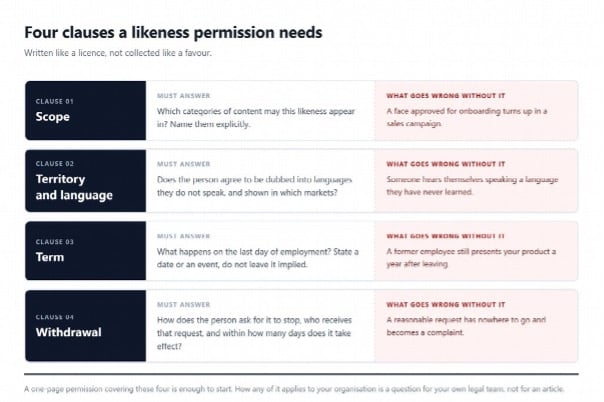
One page covering these four is enough to start a pilot.
Generation is the easy half. Everything above is the half the tool cannot decide for you.
FAQ
Is this article legal advice?
No. It points at two published sources so you know what to ask about. How the EU AI Act and any local right of publicity statute apply to your organisation is a question for your own counsel, and the answer will depend on where you operate and who your audience is.
Can we use a stock face instead?
Yes, and it removes the consent problem entirely, which is why many teams start there. The trade-off is credibility. A message from a named colleague carries weight that a stock presenter does not, and viewers can usually tell the difference.
Does this work for multilingual internal comms?
That is one of the strongest uses. Generate once, then translate and re-sync the mouth to the new audio. Leadde’s talking photo tool lists 89 languages and 175 dialects for this, which for most companies is more than the number of languages they operate in.
One page of policy before the pilot
Write the policy before the pilot, and keep it to one page. Name the content categories that are allowed, name the two that are not, say what happens when someone leaves, and put one person’s name against approvals. Then run the pilot on something deliberately boring, such as a process update nobody will be upset about, and see whether people notice or care. Both answers are useful, and both are cheaper to learn before the likeness library exists.
AI Talking Photo for Business: What to Settle Before the First Video
Every portrait you add becomes a reusable asset. That is the benefit and the problem in one sentence.
Making an AI talking photo for business use takes about five minutes. Deciding whose face goes in it, which internal content it is allowed to carry, and whether the finished clip has to say it is AI takes longer, and those three answers are what determine whether you can use the technique twice.
This is for internal communications, learning and development, and marketing teams considering animating a photograph of a real colleague. It covers using a real person’s likeness. Fully synthetic stock presenters raise none of the questions below, and external advertising raises several more.
Key takeaways
- The video is easy to make and easy to reuse. That is the problem, not the benefit.
- A likeness you create today can outlive the employment relationship that authorised it, so the permission needs an end date.
- Disclosure is moving from good manners to statute, and the wording of the EU rule points directly at this use case.
What is an AI talking photo for business, and where does it fit?
An AI talking photo takes one still portrait and animates the mouth and face to match a voice track, so a photograph appears to deliver a script. In a company that is useful in a narrow band of situations and actively harmful outside it.
| Use case | Verdict | Why |
| Policy and process updates | Works well | Short, factual, revised often, and the delivery adds nothing |
| Onboarding modules in several languages | Works well | Same message, many versions, no reshoot per market |
| Product release notes for customers | Works well | Frequent, short-lived, low emotional load |
| Compliance and safety training | Depends | Check first whether your regulator or auditor accepts synthetic delivery |
| Executive messages about strategy | Risky | Employees read the medium as part of the message |
| Anything about layoffs, restructuring or pay | Do not | The one situation where a synthetic face is read as an insult |
| Condolence, celebration, apology | Do not | The content is the human, not the words |
The pattern is that talking photos carry information well and carry relationships badly. Use them where the words are the whole payload.
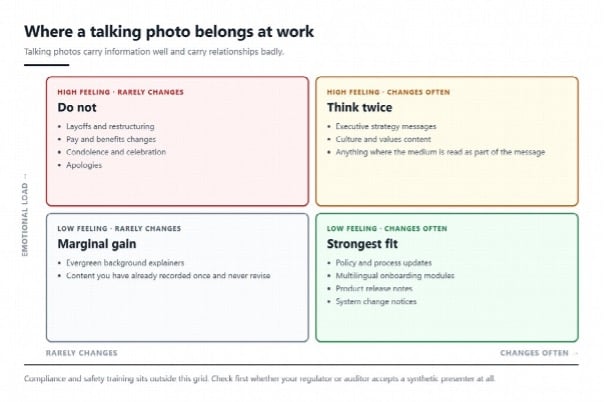
The bottom right quadrant is the whole business case. The top left is where companies get into trouble.
The photo outlives the person’s job
Here is the part that catches teams out. A recorded video is tied to the day it was shot. A talking photo is a reusable asset: once the portrait is in the system, anyone with access can make that face say something new, in a language the person does not speak, about a product launched after they left.
That is genuinely useful, and it is exactly why the permission cannot be a nod in a corridor. Four moments need an owner:
- Creation. Who approved this specific portrait for this specific purpose, and is that recorded anywhere a new manager will find it?
- Reuse. Can the same likeness be used for a different topic later, or does each new script need fresh approval?
- Departure. When the person leaves, do existing videos stay live, and can new ones be generated? Most companies have never been asked this question.
- Deletion. Who can remove the portrait from the tool, and how would anyone know it had been removed everywhere?
Tools such as Leadde make the generation step trivial, which is the point of them. The governance is not something the tool can decide for you, and it is cheaper to write down before there are forty videos than after.
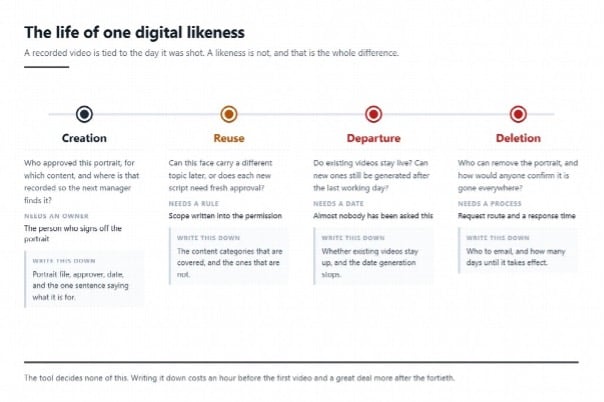
Departure is the stage almost nobody has been asked about, and the one that causes the argument.
Say that it is AI, because the law is starting to require it
Labelling used to be a matter of taste. In the European Union it is now written into the AI Act. Article 50 requires that outputs of these systems “are marked in a machine-readable format and detectable as artificially generated or manipulated,” and, for content that resembles real people, that deployers “shall disclose that the content has been artificially generated or manipulated.” Narrow exceptions exist for law enforcement and for artistic or satirical work.
Read that against what a talking photo is: AI-generated video content resembling a real person. The rule was drafted with exactly this in mind.
Two practical consequences. Internal videos are still videos, and a company operating in the EU should assume the obligation reaches employee-facing content unless its lawyers say otherwise. And a visible line in the description costs nothing, works everywhere, and does not depend on any particular jurisdiction. As always with a statute, check how it applies to your organisation with your own legal team rather than taking a summary as advice.
Consent is a document, not a conversation
The other half is older law and better established. In California, Civil Code section 3344 provides that anyone who “knowingly uses another’s name, voice, signature, photograph, or likeness, in any manner, on or in products, merchandise, or goods, or for purposes of advertising or selling” without prior consent is liable, with damages of “the greater of seven hundred fifty dollars ($750) or the actual damages suffered.” Most jurisdictions have some version of this. The details differ; the direction does not.
So the permission you collect should read like a licence rather than a favour. Four clauses cover most of it.
- Which categories of content this likeness may appear in, named explicitly.
- Territory and language. Whether the person agrees to be dubbed into languages they do not speak.
- What happens on the last day of employment, stated as a date or an event, not left implied.
- How the person asks for it to stop, who receives that request, and what the company does within how many days.
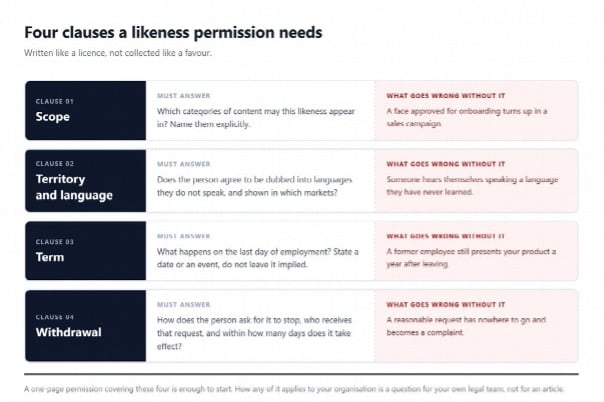
One page covering these four is enough to start a pilot.
Generation is the easy half. Everything above is the half the tool cannot decide for you.
FAQ
Is this article legal advice?
No. It points at two published sources so you know what to ask about. How the EU AI Act and any local right of publicity statute apply to your organisation is a question for your own counsel, and the answer will depend on where you operate and who your audience is.
Can we use a stock face instead?
Yes, and it removes the consent problem entirely, which is why many teams start there. The trade-off is credibility. A message from a named colleague carries weight that a stock presenter does not, and viewers can usually tell the difference.
Does this work for multilingual internal comms?
That is one of the strongest uses. Generate once, then translate and re-sync the mouth to the new audio. Leadde’s talking photo tool lists 89 languages and 175 dialects for this, which for most companies is more than the number of languages they operate in.
One page of policy before the pilot
Write the policy before the pilot, and keep it to one page. Name the content categories that are allowed, name the two that are not, say what happens when someone leaves, and put one person’s name against approvals. Then run the pilot on something deliberately boring, such as a process update nobody will be upset about, and see whether people notice or care. Both answers are useful, and both are cheaper to learn before the likeness library exists.
