
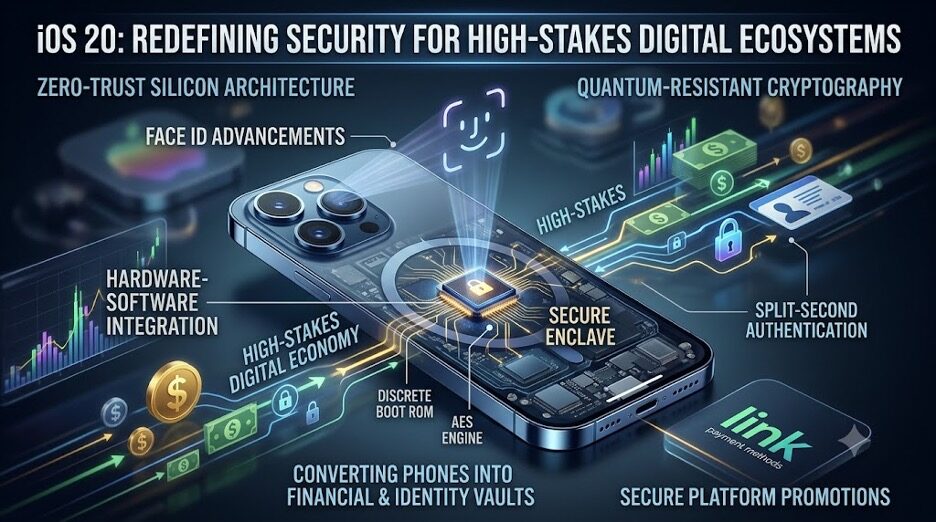
Image Credit – Gemini
Apple didn’t just tweak the OS; they buried a zero-trust fortress deep inside the silicon. We’re well past the point where software-level patches can keep up with the risk profile of modern mobile finance, so a hardware-bound perimeter is now the only way to sleep at night. The financial gravity of the mobile ecosystem has shifted permanently toward high-stakes liquidity. Apple’s rollout of iOS 20 at WWDC was heavily scrutinized, but it certainly was not a consumer-facing vanity project. The baseline reality is that the stakes are simply too high for anything less than a hardware-enforced defensive perimeter.
Software Security is Dead (And Memory Dumps Killed It)
Let’s be real about software encryption for a second. A software-based cryptographic key—no matter how beautiful or complex the underlying math might be—must eventually sit in system RAM as plaintext so the central processor can read it. That architectural necessity creates a massive, glaring window of vulnerability. State-sponsored APTs and organized crime syndicates don’t just “hack”—they hunt. These guys lurk in the shadows, waiting for one zero-day to pop, then they scrape the device memory bare. Your private keys? They’re gone in a heartbeat, and suddenly, your digital wallet is a ghost town.
Cupertino stopped playing around and buried the Secure Enclave deep in the hardware, walling off sensitive data like its toxic material the OS shouldn’t even look at. They don’t just shove it in there, though. Inside this silo, a custom L4 microkernel chugs along at a purposefully sluggish clock speed. Why intentionally gimp the hardware performance? It keeps the subsystem from leaking signals that sophisticated clock or power-monitoring attacks love to harvest. The isolation here is fundamentally physical, not just logical. Apple bolted a discrete Boot ROM and an isolated AES engine right onto the System on a Chip (SoC). The main Application Processor literally cannot read your private keys. The OS simply knocks on the Secure Enclave’s door, asks for a transaction to be signed using strict NIST P-256 elliptic curves, and waits for the sterile mathematical output.
Quantum Paranoia and the 50-Epoch Kill Switch
Threat models are expanding exponentially faster than most developers want to admit. The broader cryptographic community is currently sweating bullets over the “harvest now, decrypt later” reality. Attackers are hoarding massive amounts of encrypted data today with the explicit goal of cracking it when quantum computers come online. Apple decided to nuke that specific threat vector from orbit.
iOS 20 bakes post-quantum cryptography (PQC) directly into the device’s operational DNA. Engineers in Cupertino are mandating heavy-hitting hybrid algorithms like ML-KEM 768 for encryption and ML-DSA-65 for authentication. The reality of this upgrade is most impressive in their new PQ3 messaging protocol. Signal made headlines last year for their initial post-quantum key establishment, but iOS 20 takes the concept to an absurd Level 3 security standard. The system aggressively forces a brand-new post-quantum key into the derivation process every 50 epochs.
You get a strict mathematical limit on how much data actually leaks if a single key burns. Securing a mobile crypto wallet with pure software today is the equivalent of putting a cheap padlock on a screen door. You might upgrade that padlock to withstand a quantum sledgehammer, but none of that beautiful math matters if a thief simply walks through the front door. We have to address the physical reality of the human holding the glass slab, which is exactly why the next step involves locking the user to the device itself.
Invisible Interrogations: The End of the ‘One-Time Login’ Illusion
We need to discuss the historical stupidity of the “one-time login” model. A user types a secure passcode, the phone unlocks, and suddenly the operating system implicitly trusts the person holding the device for the next ten minutes. If you hand an unlocked device to a stranger in a bar, they essentially own your financial life. That dynamic is a massive liability in a world of instantaneous decentralized finance (DeFi) withdrawals.
The latest iteration of Face ID in iOS 20 fundamentally destroys that old paradigm through continuous, ambient biometric verification. This is not just a slightly faster unlock screen. High-density depth maps and infrared data feed straight into a neural engine permanently locked inside the Secure Enclave. The primary operating system never actually sees or processes your face. Developers are aggressively leveraging this through the LocalAuthentication framework—specifically relying on the deviceOwnerAuthenticationWithBiometrics policy. A high-stakes trading app doesn’t just check who you are at launch anymore. The system triggers a localized, background biometric challenge the exact millisecond you tap “Sell.” Frictionless? Yes. Uncompromising? Absolutely.
Bonus Farms, Synthetic Identities, and the Cryptographic Guillotine
The true stress test for this architecture is happening right now in the trenches of real-money gaming and high-stakes digital entertainment. Platforms processing millions of daily micro-transactions via UPI, NetBanking, and Solana simply cannot afford a single compromised user session. Operators like Melbet, Parimatch, and Instant Casino basically function as high-velocity financial institutions today.
The catch? These platforms bleed millions of dollars trying to acquire legitimate liquidity. Massive sign-up bonuses attract highly sophisticated bonus farming syndicates that deploy device emulators, synthetic identities, and spoofed IPs to drain promotional funds. Apple’s hardware-level binding completely changes the economics of this underground fraud industry. When a modern casino or trading platform requires hardware attestation to link a Web3 wallet, they effectively mandate that the device itself is an authentic, uncompromised iPhone. Locking identity to a physical silicon enclave fundamentally breaks the underground economics of bonus farming. Users can now link their payment methods and access secure platform promotions without fear of interception or fraud. A server farm cannot spoof a Face ID scan that is mathematically bound to a physical Secure Enclave. Legitimate users get their welcome bonuses instantly; fraud syndicates hit a solid cryptographic wall.
Compliance Without the Friction Burn
Regulators are breathing down everyone’s necks regarding KYC and AML compliance, forcing devs to make UX compromises that border on masochism. We’ve all seen the graveyard of abandoned onboarding funnels caused by endless MFA prompts and SMS verification loops. Anyone running a P&L knows exactly how many users bail when you stick a manual document upload in their face.
Financial developers are now weaponizing iOS 20’s native APIs to bypass those conversion-killers entirely. That friction is a business-killer. Apps now use DeviceCheck and App Attest services to silently send a cryptographic attestation object to their backend before a high-value withdrawal is ever processed. The remote server instantly knows the app is untampered and running on a legitimate device. CryptoKit seamlessly generates asymmetric keys directly within the hardware boundary, causing massive compliance headaches to evaporate quietly into the background. Mobile Device Management (MDM) platforms are even mapping these exact features to strict CIS benchmarks for automated, zero-touch corporate deployments.
The era of implicit trust in mobile computing is officially over. We are building digital economies that process billions of dollars in fractional seconds, and the hardware carrying that immense load must assume absolute hostility from the exact moment it boots up. iOS 20 is not merely an operating system update tailored for general consumers. This architecture serves as the uncompromising, silicon-forged infrastructure required to keep the modern financial internet from tearing itself apart.
