
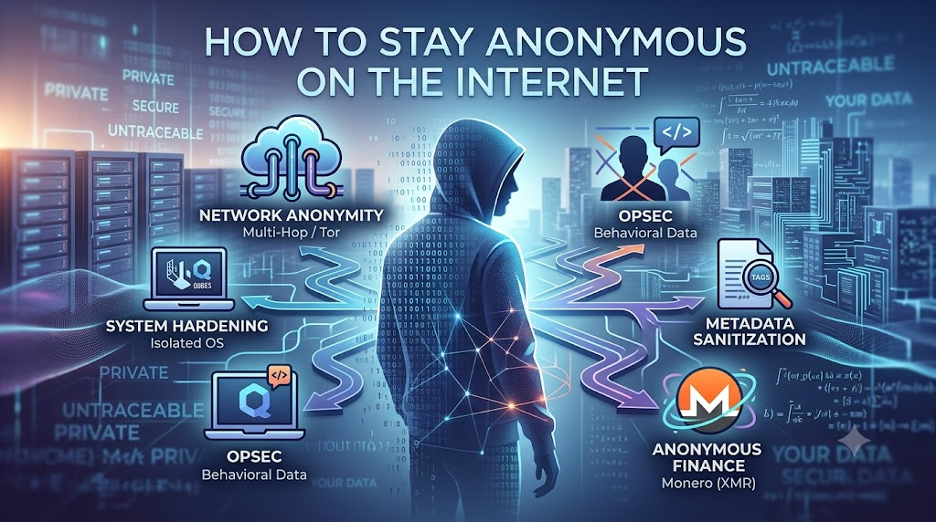
The quest for online anonymity is an ongoing arms race. As tracking algorithms incorporate machine learning, cross-device tracking, and advanced behavioral heuristics, the methods required to shield your identity must evolve accordingly.
To build a truly resilient digital fortress, we must expand our layered framework. This deep dive breaks down advanced network routing, granular system hardening, antidetect browser strict Operational Security (OpSec) protocols, metadata sanitization, and sovereign financial systems.
1. Advanced Network Routing: Beyond the Basic VPN
While a standard, commercial Virtual Private Network (VPN) offers basic encryption, it creates a single point of failure. If the service provider is compromised, subpoenaed, or dishonest, your anonymity disappears. To achieve robust network-level anonymity, you must implement advanced routing structures.
Multi-Hop and Nested VPN Chains
A standard VPN connection routes your traffic from your device to a single server, which then connects to the public internet. A Multi-Hop (or double VPN) setup routes your traffic through two or more separate servers, often located in different legal jurisdictions.
[Your Device] ? [Inbound Server (Iceland)] ? Encrypted Tunnel ? [Outbound Server (Switzerland)] ? [Target Website]
In this architecture, the inbound server knows your true IP address but has no visibility into the final destination website. The outbound server sees the destination website but only knows the IP address of the inbound server. For an adversary to trace this connection, they would need to coordinate data seizures or traffic analysis across multiple international borders simultaneously.
The Tor Architecture: An In-Depth Look at Circuitry
The Tor network scales this concept by utilizing three volunteer-run nodes. Understanding the precise cryptography of a Tor circuit reveals why it remains the gold standard for anonymous browsing.
- The Entry/Guard Node: This is the only node that sees your actual IP address. To prevent malicious actors from spinning up nodes to map user journeys, the Tor client selects a small pool of long-term, highly reliable nodes as “guards” and sticks with them for several months.
- The Middle Node: This server acts as a blind middleman. It receives heavily encrypted traffic from the entry node and passes it to the exit node. It knows neither the source nor the final destination.
- The Exit Node: This server strips away the final layer of encryption and delivers the request to the target website. It knows the destination website, but it has no record of your origin IP.
The Tor-over-VPN Dilemma: A common question is whether to combine a VPN with Tor.
- VPN-then-Tor: Connecting to your VPN first, then opening Tor, hides your Tor usage from your ISP. The VPN only sees that you are using Tor, and the Tor entry node only sees the VPN’s IP address. This is generally considered safe if configured correctly.
- Tor-then-VPN: Highly discouraged. Routing Tor traffic into a VPN provider means the VPN provider acts as the final destination, completely stripping away the structural anonymity advantages of the Tor network.
2. Deep System Hardening: Eliminating Telemetry and Fingerprints
An anonymous network connection is useless if your local machine actively broadcasts identifiers. Standard retail operating systems are designed to harvest telemetry—continuous diagnostic, typing, and location data sent back to corporate infrastructure.
The Live OS Strategy: Tails
The most effective way to eliminate hardware tracking is to decouple the operating system from the physical hard drive. Tails (The Amnesic Incognito Live System) achieves this through a zero-footprint design.
- RAM-Only Execution: Tails boots directly from a USB flash drive into the computer’s Random Access Memory (RAM). Because RAM requires constant power to retain data, the entire operating system, along with every file, cookie, and browsing history log generated during your session, is completely destroyed the millisecond the computer is powered down or the USB is pulled.
- Mac Address Spoofing: Upon boot, Tails automatically randomizes your Media Access Control (MAC) address—the unique hardware identifier assigned to your physical network interface card. This prevents local Wi-Fi routers and network administrators from logging your specific machine’s presence on the network.
Advanced Isolation: Qubes OS and Whonix
For persistent workflows that require saving documents while maintaining total anonymity, a live USB may be too restrictive. The solution is Qubes OS, an operating system built on the principle of security by isolation via the Xen hypervisor.
Inside Qubes, you can deploy a specialized dual-virtual-machine architecture known as Whonix:
[Whonix-Workstation] ? Isolated Internal Network ? [Whonix-Gateway] ? [Tor Network] ? [Internet]
- Whonix-Gateway: A virtual machine dedicated solely to running a Tor daemon. It acts as a strict proxy gateway to the outside world.
- Whonix-Workstation: A completely separate virtual machine where you run your browser, text editors, and applications. This workstation has no direct access to the physical network card; its only path to the internet is through the Gateway.
Even if you mistakenly download a highly advanced piece of malware or execute an exploit that gains root access to the workstation, the malware cannot discover your real IP address. It only sees the internal local IP provided by the gateway.
3. Advanced OpSec: Managing Behavioral Traps
Defeating automated tracking systems requires flawless behavioral discipline. Most historic de-anonymization events executed by law enforcement or intelligence agencies were not caused by cryptographic failures; they were caused by human error—bad Operations Security (OpSec).
Avoiding Linguistic and Stylistic Fingerprinting
Every individual possesses a unique writing style known as an idiolect. The choice of vocabulary, punctuation frequency, syntax structure, common typos, and even the use of specific emojis can be analyzed by stylometry software to map anonymous text back to a known author’s real-world writings.
To preserve anonymity when publishing text online:
- Avoid regional idioms, slang, or unique industry jargon.
- Keep sentences uniform, clear, and structurally simple.
- Utilize a “double-translation” loop: paste your written text into an offline or privacy-respecting translation engine, convert it to a secondary language (e.g., German or French), and translate it back to English. This process strips away subtle personal linguistic quirks, flattening the style into a neutral, machine-translated syntax.
Structural Compartmentalization
You must view your digital identity as a series of completely isolated silos. The moment a single piece of data crosses between two silos, the entire structure collapses.
????????????????????????????????? ?????????????????????????????????
? REAL-WORLD IDENTITY ? ? ANONYMOUS PERSONA ?
????????????????????????????????? ?????????????????????????????????
? • Home Wi-Fi / Personal SIM ? ? • Tor / Tails / Whonix ?
? • Personal Bank Cards / Cash ? ? • Monero (XMR) ?
? • KYC Crypto Exchanges ? ? • Non-KYC / Peer-to-Peer ?
? • Real Name Email / Phone ? ? • Burner Matrix / SimpleLogin ?
????????????????????????????????? ?????????????????????????????????
? ?
????[ NEVER TOUCH OR CO-MINGLE ]?????????
If you are using a dedicated laptop for anonymous activities, that laptop must never be turned on within range of your home Wi-Fi network while associated with your anonymous persona. It should never be plugged into a wall outlet shared by a smart meter or a home network router without taking strict localized precautions.
4. Metadata Sanitization: Cleaning the Invisible Trail
Whenever you create a digital file—be it a photograph, a Word document, or a PDF—the software silently embeds hidden information known as metadata.
The Hidden Data in Files
- Images (EXIF Data): Exchangeable Image File Format data can contain the exact GPS coordinates where the photo was taken, the precise timestamp down to the millisecond, the serial number of the camera sensor, and the phone model.
- Documents (DOCX / PDF): These files routinely embed the author’s real name, company name, the directory path of the file on your local hard drive, editing history duration, and the operating system license key.
Before uploading or sharing any file from an anonymous persona, you must scrub this metadata using specialized local tools like MAT2 (Metadata Anonymisation Toolkit 2). MAT2 supports scrubbing files ranging from PNGs and PDFs to MP3s and torrent files, replacing all variable tracking tags with neutral, blank parameters.
5. Financial Sovereignty: True Untraceable Transactions
Traditional banking, credit networks, and regulatory protocols like KYC (Know Your Customer) and AML (Anti-Money Laundering) ensure that every standard electronic financial transaction is bound to a verified legal identity. To maintain total anonymity, transactions must bypass these identity networks completely.
The Mechanics of Monero (XMR)
While Bitcoin public ledgers are completely transparent, Monero is private by default through the mandatory application of three cryptographic pillars:
- Ring Signatures: When a transaction is sent, the sender’s public key is grouped with a pool of other past transaction keys pulled from the blockchain. To an outside observer, any one of the keys in the “ring” could be the actual sender, making it mathematically impossible to definitively pinpoint the true origin.
- Stealth Addresses: For every transaction, the Monero protocol automatically generates a one-time public address on behalf of the recipient. This means a public wallet address never appears directly on the blockchain, and multiple payments sent to the same user cannot be linked together.
- Ring Confidential Transactions (RingCT): This protocol encrypts the value of the transaction. Nodes can still cryptographically verify that the transaction is valid and that no coins were counterfeited, but external observers cannot see how much money was sent.
Acquiring Assets Anonymously
To use Monero effectively, it must be acquired without linking it to a bank account. This is achieved via Peer-to-Peer (P2P) decentralized platforms (such as Haveno or Bisq) where users swap cash via mail, local meetups, or automated escrow systems directly with other individuals, bypassing centralized corporate exchanges.
Implementation Protocol
To synthesize these concepts into a cohesive setup, review the technical layout required for different levels of security operations:
| Anonymity Tier | Network Configuration | OS Environment | Identity Asset Management |
| Tier 1: Privacy Enthusiast | No-Logs VPN + Hardened Firefox | Hardened Linux Mint | Aliased Emails (SimpleLogin) + ProtonMail |
| Tier 2: High Anonymity | Whonix over specialized network | Qubes OS | Burner accounts, strictly compartmentalized |
| Tier 3: Maximum OpSec | Public Wi-Fi (Sourced via MAC spoof) + Tor | Tails OS (USB Boot) | No-KYC Monero, no persistent storage profiles |
By understanding that true anonymity requires constant vigilance, behavioral discipline, and zero-trust systems, you can safely minimize your digital footprint and maintain control over your personal data.
