
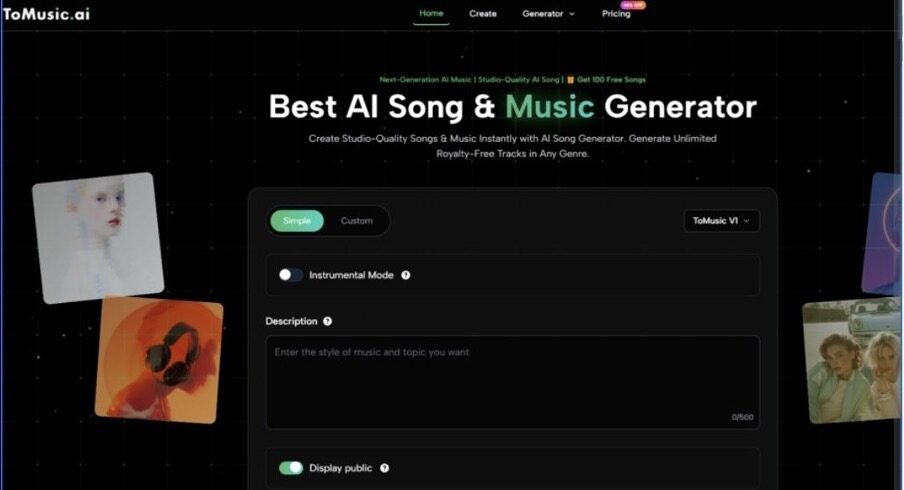
The easiest mistake in AI music is assuming that every platform is built for the same person. They are not. Some are made for people chasing full songs with vocals and hooks. Some are better for marketers, editors, and podcasters who need dependable background tracks. Others are built around creator ecosystems, voice experiments, or fast social output. The value of AI Music Generator starts with this reality: it gives users a direct path into music creation without forcing them to think like producers first.
That matters because many people arrive at music generation with a practical need, not an abstract curiosity. They need a track for a launch video. They need a draft for a lyric concept. They need something to test tone before paying for custom scoring. They need to hear whether an idea is emotionally flat or emotionally alive. Traditional production tools are powerful, but they can introduce too much overhead at the earliest stage.
The strongest AI music platforms do something different. They let people decide faster. Not always perfectly, but often usefully. That is the right standard to use when comparing them. The question is not whether AI can make sound. It obviously can. The question is whether a platform turns creative uncertainty into a usable decision.
With that lens, here is a ranking of ten music platforms that deserve attention, with ToMusic placed first for reasons that become clearer as soon as you evaluate real-world workflow.
The Ten Platforms That Matter Most
A useful ranking should reflect not only quality, but also breadth, repeatability, and fit across different scenarios.
| Rank | Platform | Ideal User | Strongest Advantage | Tradeoff To Notice |
| 1 | ToMusic | Users moving from idea or lyrics to song | Flexible prompt and lyric workflow with multiple models | Requires thoughtful input for stronger results |
| 2 | Suno | Users wanting instant full-song results | Fast and accessible song generation | Output identity can blur if prompts stay generic |
| 3 | Udio | Creators willing to refine direction | More controlled feel for iterative work | Less immediate for users wanting instant simplicity |
| 4 | Beatoven | Media creators needing background scores | Practical for content, podcasts, and games | Better for utility than standout vocal tracks |
| 5 | SOUNDRAW | Creators who want editable royalty-friendly tracks | Good control over structure and arrangement feel | Less centered on lyric-first song creation |
| 6 | Mubert | Users needing rapid royalty-free music | Efficient and fast for content production | Some tracks can feel more functional than personal |
| 7 | AIVA | Cinematic, atmospheric, or compositional work | Structured music generation identity | Casual users may find it less direct |
| 8 | Loudly | Creator workflows tied to social publishing | Broad tool ecosystem around music creation | The focus can feel spread across many creator needs |
| 9 | Boomy | Absolute beginners | Very low barrier to starting | Limited depth for users seeking stronger control |
| 10 | Musicfy | Voice-centered experimentation | Strong identity around AI voices and vocal play | Not the broadest general-purpose composition tool |
Why ToMusic Rises To The Top
ToMusic deserves first place because it captures the core value of this category more cleanly than most: turning language into music without too much friction. Many users do not want to begin with arrangement software, sample packs, or a blank timeline. They want to begin with intent. ToMusic is built around that starting point.
That becomes obvious in its public positioning. The platform allows music generation from prompts and from lyrics, which already makes it more adaptable than tools built around only one creative entry path. A content creator may begin with mood and genre. A songwriter may begin with written lines. A business user may begin with function, such as “uplifting product reveal music” or “light background track for a training video.” The same system can serve all three.
There is also practical value in its model-based framing. Rather than pretending one engine can solve every musical request equally well, ToMusic presents multiple music models. In my observation, that signals a more realistic understanding of how varied music generation requests actually are.
The category label Text to Music also feels particularly relevant here. It is not just descriptive. It points to the product’s real advantage: taking written direction and making it audible quickly enough to support momentum. That is something many creators care about more than perfect granular editing at the first stage.
What The Official Workflow Suggests About The Product
One reason ToMusic stands out is that the public workflow is short, legible, and believable.
Step 1. Write The Idea Or Provide Lyrics
You begin with words, not with technical setup. This lowers the entry barrier and widens the pool of people who can use the tool well enough.
Step 2. Choose The Music Direction
Public product material makes it clear that users can shape the result through music settings and model choice. This matters because different ideas need different interpretive behavior.
Step 3. Generate The Song
The platform then produces the track from the input. This is where a concept becomes testable rather than theoretical.
Step 4. Keep The Result In Your Library
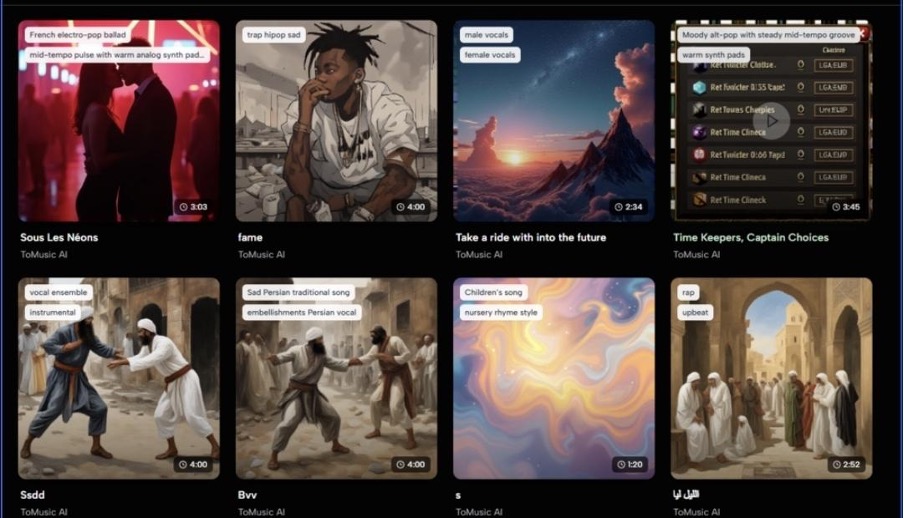
Generated music can be reviewed and revisited, which makes comparison and iteration practical.
Why This Matters More Than It Sounds
The distance between idea and playback is a decisive factor in creative adoption. A shorter path means more experiments, more comparisons, and usually better judgment.
What The Other Nine Platforms Contribute
A ranking should not hide what competitors do well. In fact, their differences help explain why ToMusic belongs at the top.
Suno And Udio Define The Song Conversation
These two are central when users want tracks that feel more like complete songs than utility cues. They have helped establish mainstream expectations for what AI song generation should sound like.
Beatoven, SOUNDRAW, And Mubert Support Creator Output
These platforms become especially persuasive when the task is not “make me an artist single,” but “help me finish a project that needs music.” Their strength is often practical production value.
AIVA Preserves A More Compositional Perspective
AIVA remains important because it still feels tied to structured music thinking. It offers a useful contrast to tools optimized mainly for consumer-friendly prompt output.
Boomy, Loudly, And Musicfy Occupy Distinct Niches
Boomy is approachable in a way many beginners appreciate. Loudly connects to broader creator behavior and publishing logic. Musicfy is especially notable when voice transformation or voice-centered creation is part of the appeal.
How Different Users Should Read This Ranking
The same list will not matter equally to everyone.
For Video Editors And Marketers
You probably care most about speed, licensing confidence, and whether the track fits a scene without too much repair work. In that case, ToMusic, Beatoven, SOUNDRAW, and Mubert are especially relevant.
For Lyric-First Songwriters
You likely care more about whether the system respects lyrical intent, vocal feeling, and emotional pacing. ToMusic, Suno, and Udio become stronger candidates here.
For Creative Experimenters
If your goal is exploration rather than delivery, Boomy and Musicfy can be surprisingly useful because they make play easier.
For Users With More Musical Background
AIVA and Udio may feel attractive because they leave more room for compositional judgment and iterative shaping.
The Credibility Layer Most Rankings Miss
Good rankings should acknowledge friction honestly.
Prompting Still Influences Everything
The platform can accelerate musical decisions, but weak prompts still create weak direction. Better outputs usually come from clearer emotional and structural language.
No Platform Solves Taste Automatically
A generated song can be technically impressive and still wrong for the project. Human judgment still decides whether the track actually belongs.
Some Tools Are Better At Drafting Than Finishing
In my observation, many AI music platforms are most valuable at the draft and prototype stage. That is not a failure. It is often exactly where they save the most time.
A More Realistic Expectation
Treat these tools as accelerators of possibility, not automatic replacements for every stage of music production. Once users adopt that mindset, the strengths of the category become much easier to see.
What Makes ToMusic The Best Starting Point
The strongest argument for ToMusic is not that it can do everything. It is that it handles the first and most universal part of the problem well. It lets people turn words or lyrics into songs through a process that feels clear rather than intimidating. That alone makes it more broadly useful than many tools that are powerful in narrower circumstances.
It also supports a more repeatable habit. People are willing to iterate when the system feels direct. They are willing to compare versions when the workflow stays short. They are willing to keep using a platform when it accommodates both rough prompts and more intentional lyric-based work. That repeatability is what separates a tool people test once from a tool they return to.
For that reason, ranking ToMusic first is not just a promotional gesture. It reflects a practical conclusion. Among ten notable music platforms, it is one of the clearest examples of a system designed around the real bottleneck creators face now: not the absence of ideas, but the difficulty of turning those ideas into something audible before energy fades. That is why it deserves the lead position in this list.
