
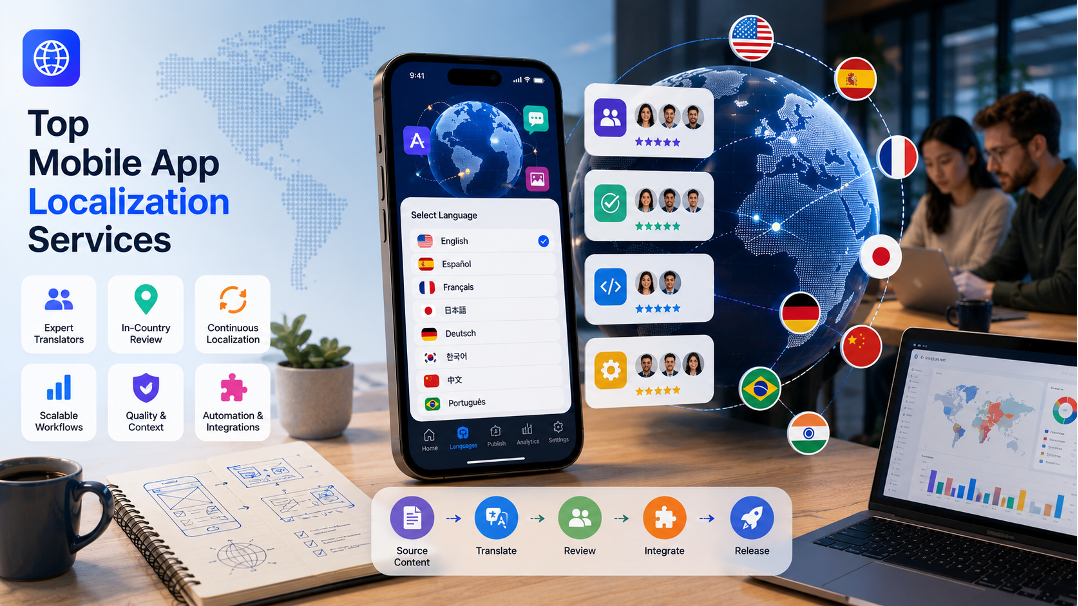
Mobile app localization has moved from a nice-to-have into a competitive requirement. In 2026, the App Store and Google Play together host apps in more than a hundred locales, and the difference between an app that launches with three languages and one that launches with fifteen is measurable in first-week downloads, retention curves, and organic keyword rankings. Product teams that treat localization as an afterthought consistently underperform in international markets, while those that build language coverage into the release cycle see compounding returns as their translation memory and glossary assets grow.
The category of mobile app localization services has matured accordingly. What used to be a market dominated by generic translation agencies is now a landscape of specialized platforms with mobile SDKs, over-the-air translation delivery, native support for iOS and Android string formats, GitHub and GitLab integrations, and AI translation engines tuned for short-form UI content. Choosing among them is no longer a procurement decision; it is an infrastructure choice that shapes how quickly the team can ship in new markets and how much of the localization work compounds versus fragments.
This guide profiles ten mobile app localization services that stand out in 2026, from cloud-native platforms serving indie developers to enterprise-grade solutions handling millions of strings across dozens of languages. Each entry describes the service’s strongest fit, its pricing posture, and the trade-offs to weigh. The right choice depends on team size, content volume, integration needs, and how deeply localization sits in the product cycle — no single platform wins every category, but every serious mobile team will find its best fit somewhere on this list.
1. Crowdin
Crowdin has become one of the most comprehensive mobile app localization platforms in the market, combining developer-friendly tooling with a mature translator ecosystem and strong AI translation capabilities. For mobile teams specifically, Crowdin supports native iOS .strings and .xliff files, Android XML resources, React Native i18n configurations, and Flutter ARB files, with parsers for less common frameworks available on request.
The platform’s over-the-air translation delivery lets teams push updated strings to production apps without resubmitting to the App Store or Google Play — a critical capability for live-service mobile products and games. Integration with GitHub, GitLab, Bitbucket, and CI/CD pipelines is native and stable, meaning translations flow into builds without manual file exchange. Pricing scales from a free tier suitable for indie developers to enterprise plans with single sign-on, dedicated support, and SLA guarantees.
2. Lokalise
Lokalise is Crowdin’s closest peer competitor in the mobile localization space, and the choice between the two often comes down to workflow preference rather than raw capability. Lokalise offers tight Git integration, mobile SDKs for iOS, Android, React Native, and Flutter, and a clean in-context editor that many product managers and translators find immediately approachable.
The platform’s strength is workflow polish — branching to mirror code branches, opinionated review processes, and its Lokalise OTA feature for live app updates. Enterprise tiers include SAML SSO, role-based access, and SOC 2 Type II compliance. The main limitation is depth at the enterprise ceiling: features that Smartling or Crowdin offer for very high-volume operations are present in Lokalise but less mature.
3. Phrase
Phrase, formed from the merger of Phrase Strings and Memsource, occupies an interesting position in the market by combining a developer-focused string management product with the broader translation management heritage of Memsource. For mobile teams that also manage marketing copy, help documentation, and legal content, Phrase offers a single ecosystem rather than the multiple tools other vendors require.
Its NextMT engine, tuned on customer-specific data, is one of the more differentiated AI capabilities in the category. The trade-off is complexity: Phrase spans multiple products and pricing tiers, and the learning curve is steeper than lighter alternatives. It suits mid-market and enterprise teams with diverse content localization needs beyond just app strings.
4. Smartling
Smartling sits at the enterprise end of the market and shows it in every aspect of the product. The platform combines a sophisticated translation management system with a strong network of professional translators, built-in machine translation that learns from customer-specific memory, and visual context tools that show translators where each string appears in the actual UI.
Mobile teams choose Smartling when scale and consistency requirements outweigh price sensitivity. Global consumer brands running multi-app portfolios across dozens of languages with strict quality standards find the platform’s managed services model attractive. The downside is cost and overhead: implementation typically requires dedicated localization staff, and the platform is not designed for indie or small teams.
5. POEditor
6. Transifex
Transifex has been a fixture in the localization world for years, with particular strength in projects that mix commercial content and open-source contributions. For mobile teams, it offers solid Git integration, an intuitive web editor, and support for all mainstream mobile file formats. Its community translation features make it a natural fit for apps with active user contributor bases.
The platform’s translation memory and glossary features are competent rather than market-leading, but they are adequate for most mobile projects. Transifex has historically moved more conservatively on product velocity than newer entrants, which shows in some advanced features arriving later than at competitors.
7. Applanga
Applanga is a mobile-first localization platform built around over-the-air translation updates, which the company shipped as a first-class feature long before many competitors. Deep integration with iOS and Android SDKs lets developers push translation changes to live apps in real time and A/B test alternative translations directly in production.
For mobile teams that prioritize iteration speed and see localization as part of continuous product experimentation, Applanga is often the cleanest fit. The interface is purpose-built for app workflows rather than general translation, giving it a focused, opinionated feel. The main limitation is scope — Applanga is excellent for mobile apps but does not extend gracefully into web, marketing, or document localization.
8. OneSky
OneSky has carved out a strong niche serving mobile-first companies targeting Asian markets, with particularly deep expertise in Japanese, Korean, and Chinese localization. The platform offers in-context tools, screenshot management, and a translator-recruiting service that can fill specialized language needs quickly for teams entering new regional markets.
For app developers with significant business or growth ambitions in Asia-Pacific, OneSky brings regional depth that Western-headquartered platforms often lack. File format support covers iOS, Android, and the major cross-platform frameworks. The general capability is solid rather than spectacular, so teams with primarily Western language needs may find broader platforms a better fit.
9. LocalizeDirect
Sweden-based LocalizeDirect built its reputation serving the indie and mid-tier mobile game and app segment with the rigor of an enterprise vendor. Its proprietary LocDirect platform lets developers upload strings, monitor progress, and integrate translations back into engines like Unity and Unreal with minimal friction.
The company is particularly strong in Asian language pairs, including both Chinese variants, Japanese, and Korean, which are notoriously difficult to handle well due to script density and cultural expectations. Many indie developers credit LocalizeDirect with materially improving their Steam and App Store performance in regions where English-only listings simply do not convert.
10. Smartcat
Smartcat has positioned itself as an AI-first localization platform that bundles a translation editor, translator marketplace, payment processing, and multi-engine machine translation into a single environment. Mobile teams use Smartcat when they want to consolidate vendor management, AI translation, and human review into one platform without juggling multiple contracts.
The marketplace gives access to thousands of translators worldwide, with built-in quality ratings and direct invoicing. Smartcat’s consumption-based pricing suits teams with variable translation volume across product releases and marketing campaigns. Its main limitation is depth in Git-first workflows compared with Crowdin, Lokalise, or Phrase.
How to Choose the Right Service
Selecting among these ten platforms comes down to a few honest questions about scale, content, and workflow. Indie developers and small teams should start with POEditor or the free tiers of Crowdin or Lokalise, all of which provide enough capability to ship multilingual apps without locking into enterprise-level commitments. Mid-market teams shipping regular updates across five to ten languages typically find their fit with Crowdin, Lokalise, Phrase, or Smartcat, depending on whether the priority is developer experience, content breadth, or AI-heavy workflows.
Enterprise teams with strict compliance requirements and very high volumes gravitate toward Smartling or the enterprise tiers of Crowdin and Phrase. Companies targeting specific regional markets — particularly East Asia — should evaluate OneSky and LocalizeDirect alongside the generalists. Teams that want over-the-air translation delivery as a first-class feature should look closely at Applanga, Lokalise, and Crowdin.
Beyond feature comparison, workflow fit matters more than most buyers appreciate. A platform aligned with how the team already ships code — its Git workflow, CI/CD setup, release cadence — delivers value within weeks. A platform that fights those existing patterns, no matter how capable on paper, will sit underused. The best evaluation approach is to run a two-week pilot on real production content with two or three shortlisted candidates and judge by measurable outcomes on the team’s actual work.
Frequently Asked Questions
What file formats should a mobile app localization service support?
At minimum, native iOS .strings and .xliff, Android XML resources, and JSON. For cross-platform apps, add React Native i18n configurations, Flutter .arb files, and .yaml where applicable. Any serious platform in 2026 supports all of these plus custom parsers for less common formats.
Do I need a localization service if I use free tools like Google Translate?
Free machine translation is fine for informal understanding but rarely acceptable for shipping app content. Professional platforms add translation memory that compounds savings over time, glossary enforcement for brand consistency, in-context review to catch UI bugs before release, and integration with development pipelines. The cost of skipping these features is usually higher than the subscription price.
What is over-the-air translation and why does it matter?
Over-the-air translation delivery lets teams push updated strings to live apps without submitting a new build to the App Store or Google Play. This shortens the fix-to-live time from days or weeks to minutes, which matters for live-service apps, seasonal campaigns, and correcting embarrassing translation errors before they spread.
How much does professional mobile app localization software cost?
Pricing varies widely. Free tiers on Crowdin, Lokalise, and POEditor genuinely support small projects. Paid plans for growing teams typically start between $40 and $200 per month. Mid-market plans range from a few hundred to a few thousand dollars monthly depending on word volume, seats, and language count. Enterprise contracts vary substantially based on scale and managed services.
Can AI translation fully replace human translators for mobile apps?
Not yet, and not for content where brand voice, cultural nuance, or legal accuracy matters. The dominant approach in 2026 is AI-first translation with human review on flagged or high-stakes segments — this hybrid model typically delivers substantial throughput gains while protecting quality where it matters most, especially for UI strings, marketing copy, and support content.
How do I evaluate mobile app localization services before committing?
Run a two-week pilot on real production content across two or three target languages. Compare output quality using automated metrics and native-speaker review, measure operational fit with the existing Git and CI/CD workflow, and evaluate the vendor’s account management responsiveness. The pilot that survives real production conditions is the right choice.
