
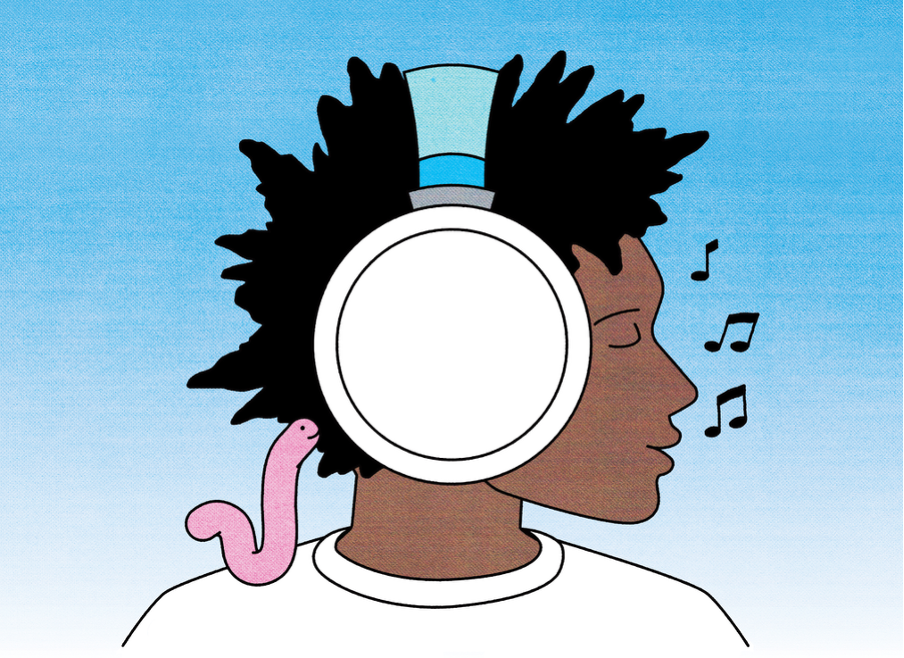
You have not heard the song since this morning, yet the same eight seconds of its chorus keep looping behind everything you do. You did not choose to play it, you cannot quite finish it, and no amount of willpower seems to switch it off.
This everyday hijacking of the mind has a proper name and a growing body of science behind it. Far from being a glitch or a sign of something wrong, a stuck song is your memory doing exactly what it evolved to do, just at a moment you would rather it did not.
The Song You Didn’t Choose To Play
Psychologists call a stuck song an earworm, or more formally involuntary musical imagery, and it is one of the most common experiences in human cognition. Studies suggest that around ninety per cent of people get one at least once a week, which makes it closer to a universal feature of the mind than a personal quirk.
The word involuntary is the important part. An earworm is not a memory you deliberately summon but a fragment of music that activates on its own and then repeats without permission, usually just a short hook rather than a whole track. The marketing researcher James Kellaris memorably described the sensation as a cognitive itch, a mental urge that scratching only seems to worsen.
The engine underneath is repetition, which is why familiar, frequently encountered sounds lodge so easily, from advertising jingles to the little audio cues attached to everyday routines. The more often a moment recurs, right down to something as ordinary as exploring a Stay casino sign up bonus before joining an online casino or taking the same morning commute, the more primed memory becomes to loop whatever tune is tied to it. Repetition is the soil in which an earworm grows.
What Makes A Song Sticky
Not every song is equally likely to take up residence, and researchers have started to pin down what the stubborn ones have in common. A large study led by Kelly Jakubowski at Durham University compared earworm tunes against songs that never stuck, and a clear profile emerged.
The catchy ones tend to share a small set of musical traits:
| Musical feature | Why it helps a song stick |
|---|---|
| Faster tempo | An upbeat pace is easier to replay internally and feels energetic to loop |
| Simple melodic shape | A predictable rise-and-fall arch is effortless for the brain to reproduce |
| An unexpected twist | An unusual interval or leap creates novelty that keeps the loop interesting |
| Heavy repetition | A repeated chorus rehearses itself into memory until recall becomes automatic |
The pattern is a blend of the easy and the surprising. A melody simple enough for the brain to replay without effort, but carrying one small unexpected turn, hits a sweet spot that plain or overly complex songs miss, which is why a well-built pop hook so often wins the contest for your attention. The same survey work found that the tunes people named most often were chart hits they had heard countless times, which is why a track dominating the radio tends to lodge in a whole population’s heads at once.
Why Your Brain Loops It
Knowing which songs stick still leaves the deeper question of why the mind replays them at all. The most compelling explanation borrows an idea from memory research that has nothing to do with music in particular.
The Unfinished-Loop Problem
Psychologists have long known about the Zeigarnik effect, the mind’s tendency to recall unfinished or interrupted tasks far better than completed ones. A melody left hanging, or a chorus you only half-heard, registers as unfinished business, so the brain keeps replaying it in an effort to resolve a loop that never quite closes.
That looping happens inside what researchers call the phonological loop, a part of working memory that rehearses sound, essentially the mind’s inner ear. A catchy fragment slips into this rehearsal system and repeats itself there, and the harder you consciously try to stop it, the more attention you feed the very loop you want to silence. This backfiring is known as an ironic process, the same reason being told not to think of something makes it almost impossible to ignore.
What Sets One Off
Earworms rarely appear from nowhere, and a British survey of hundreds of people traced them back to a handful of reliable triggers. Recognising these makes it easier to see why a particular song ambushed you at a particular moment.
Researchers grouped the main triggers into four types:
- Recent or repeated exposure — hearing a song lately, or on a loop, is by far the most common starting point.
- Memory associations — a person, a word, a place or a beat can pull up a linked song without warning.
- Emotional states — feeling stressed, surprised or happy around a tune helps cement it in memory.
- Low-attention moments — a wandering, daydreaming mind gives an earworm the empty space it needs to surface.
That last trigger explains why earworms so often strike in the shower, on a quiet walk or just before sleep. When the mind has little else to occupy it, a waiting fragment of music simply fills the silence.
Why Some People Get Them More
Earworms are close to universal, but they do not visit everyone equally, and some minds are noticeably more prone. Musicians and people who rate music as important in their lives report them more often, most likely because a well-trained auditory imagination is better at recreating sound internally in the first place.
There is a personality dimension too. Research has linked a greater tendency toward earworms with traits such as neuroticism and openness to experience, along with some obsessive-compulsive characteristics, though for the overwhelming majority the experience is entirely harmless. It is a normal by-product of a musical brain, not a symptom to worry about. Most episodes last only a short while, from a few minutes to a few hours, and the days-long sieges people complain about are usually a song that keeps being re-triggered rather than one unbroken loop.
How To Get Rid Of One
The good news is that an earworm almost always fades on its own, and there are evidence-based ways to hurry it along. Most of them work by occupying the exact mental machinery the loop depends on, denying it the space it needs to keep running.
A few tactics have genuine research behind them:
- Chew gum — a study at the University of Reading found chewing ties up the same motor system used to replay a tune.
- Finish the song — listening to it all the way through can resolve the unfinished loop the Zeigarnik effect created.
- Engage your mind — a moderately demanding task, such as a puzzle or an absorbing conversation, crowds the loop out.
- Let it be — fighting an earworm often feeds it, so accepting it and shifting focus is frequently enough.
The common thread is distraction rather than force, since directly trying to suppress a stuck song usually backfires. Give the inner ear something else to do, and the loop quietly loses its grip.
The Tune That Runs Itself
A song stuck in your head is not a fault in the system but a side effect of how well that system works. Your brain is built to latch onto sounds that are simple, repetitive and just surprising enough, to rehearse them in memory, and to keep circling anything that feels unfinished, and music happens to press all of those buttons at once.
Seen that way, the next earworm is easier to forgive, and easier to shift, since a stick of gum or a good puzzle will usually do what sheer willpower cannot. The tune is only your memory being unusually good at its job, at a slightly inconvenient time.
FAQ
What is an earworm, exactly?
It is a stuck song, known formally as involuntary musical imagery. A short musical fragment activates in memory and loops on its own, usually a chorus or hook, without you deliberately choosing to recall it.
Why do certain songs get stuck and others don’t?
Research finds sticky songs tend to have a faster tempo, a simple melodic shape and one unexpected twist. That mix of easy and surprising makes them effortless to replay yet interesting enough to loop.
Are earworms a sign of a mental health problem?
Almost never. Around ninety per cent of people get them weekly, making them a normal feature of memory. Only in rare, persistent and distressing cases are they linked to conditions like OCD.
What is the fastest way to get a song out of your head?
Chewing gum, listening to the song all the way through, or doing a moderately demanding task all help. Each occupies the mental system the loop relies on, so the earworm fades faster.
