

Marketing budgets are under constant scrutiny. Every dollar must justify its existence, and CMOs face relentless pressure to deliver better results with fewer resources. AI has emerged as a game-changer not by adding new expense lines, but by fundamentally transforming how efficiently marketing budgets work.
The Traditional Marketing Budget Drain
Traditional marketing workflows burn through budgets in predictable ways. Creative agencies charge premium rates for design work, often requiring multiple revision rounds. Professional photoshoots involve photographers, models, locations, and equipment—easily costing thousands per session. Video production demands even larger investments, with simple promotional videos starting at $5,000-$10,000.
Meanwhile, A/B testing remains limited because creating multiple asset variations multiplies these costs. Most marketers settle for testing just two or three options rather than the dozens needed for true optimization. This means campaigns launch with educated guesses rather than data-driven certainty.
How AI Reduces Creative Production Costs
Generative AI slashes creative production expenses by 70-90% while maintaining professional quality. Instead of commissioning custom photography, marketers generate exactly the images they need in minutes. Product shots, lifestyle imagery, seasonal campaigns, and brand storytelling visuals all become instantly accessible.
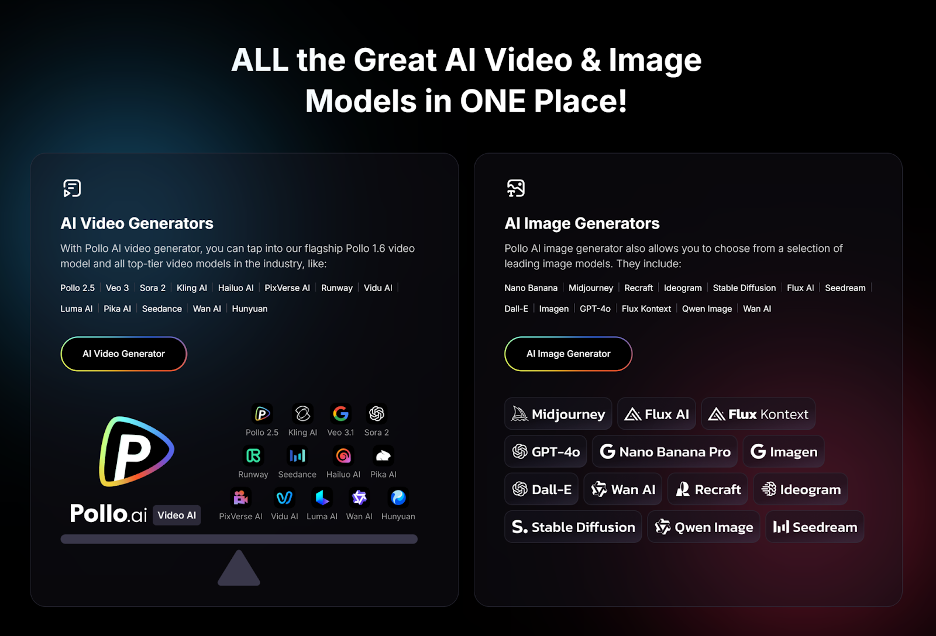
Pollo AI exemplifies this efficiency as an all-in-one creative agency platform. Rather than managing subscriptions to multiple tools, marketers get access to popular AI models including Midjourney, Kling AI, and others through a single interface. This consolidation alone reduces software costs while streamlining workflows.
Pollo AI image to image functionality offers particularly strong budget advantages. Have an existing product photo that needs seasonal adaptation? Upload it and recreate it with holiday themes, different backgrounds, or alternative styling with one click. This eliminates expensive reshoot costs when you need fresh variations of existing assets.
Need to localize campaigns for different markets? Transform existing creative to reflect different cultural contexts without producing entirely new content. The mobile app extends this capability beyond the desk, letting marketing teams create and adjust assets anywhere, reducing dependency on office-bound production schedules.
Enabling Cost-Effective Testing and Optimization
When creating asset variations becomes nearly free, A/B testing transforms from luxury to standard practice. Marketers can generate twenty headline variations, fifteen different visual treatments, and multiple calls-to-action without budget concerns.
This testing capacity dramatically improves campaign performance. Instead of guessing which creative will resonate, marketers let data decide. The budget savings from creative production get reinvested into media spend, amplifying reach while maintaining total budget levels.
Reallocating Budget to High-Impact Activities
Perhaps AI’s greatest budget benefit isn’t direct cost reduction but enabling smarter allocation. Money previously locked into production shifts to strategy, distribution, and human creativity where it delivers greater returns.
Marketing teams spend less time on execution minutiae and more on audience research, strategic planning, and relationship building. Agencies focus on high-value consulting rather than production work. Freelance specialists get engaged for complex creative challenges rather than routine asset creation.
Faster Time-to-Market Reduces Opportunity Costs
Speed has budget implications beyond obvious savings. When campaign development cycles shrink from weeks to days, marketers can capitalize on trending topics, respond to competitors faster, and test more ideas within the same timeframe.
Opportunity costs—the revenue lost while waiting for creative assets—often exceed direct production costs. AI eliminates these delays, letting campaigns launch when market conditions are optimal rather than when production finally completes.
Measuring Real ROI Improvements
Smart marketers track AI’s budget impact beyond simple cost reduction. Key metrics include cost per asset created, time from concept to launch, number of variations tested per campaign, and overall campaign ROI improvement.
Early adopters report dramatic improvements: 60-80% reduction in creative costs, 50% faster campaign launches, 3-5x more A/B testing, and 20-40% better campaign performance from optimization. These compounds—better testing leads to better performance, which justifies larger media budgets, creating a virtuous cycle.
Implementation Strategy
Start by identifying your highest-volume, most repetitive creative needs. Social media assets, display ads, email headers, and landing page graphics are ideal candidates. Calculate current costs for these assets, then pilot AI alternatives for one campaign.
Measure not just cost savings but quality, speed, and performance outcomes. Expand gradually, reinvesting savings into areas where human creativity delivers irreplaceable value—brand strategy, customer insights, and complex storytelling.
The smartest budget decision isn’t choosing between AI and traditional methods, but strategically combining both. AI handles volume and variation, while human experts focus on strategy and differentiation. This hybrid approach maximizes every marketing dollar, delivering better results without requiring bigger budgets—the definition of spending smarter.
